
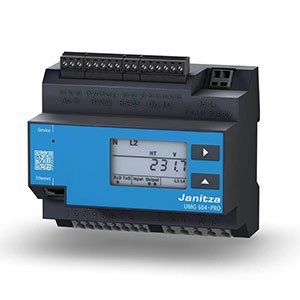
Description
Janitza UMG 604-PRO Power Analyzer
The Janitza UMG 604-PRO is a DIN-rail power analyzer that combines energy metering, power quality monitoring, and network communication in one device. It measures voltage, current, power, and energy in low-voltage networks, analyzes harmonics and unbalance, and records disturbances such as voltage dips, short interruptions, and transients. It also works as an Ethernet gateway, so Modbus RTU devices on its RS-485 bus can reach an Ethernet network through the same unit. The UMG 604-PRO belongs to Janitza’s energy management range.
The analyzer is used where one instrument has to do several jobs: collect consumption data for cost allocation, watch the quality of the supply, pass measurements to a building management system or PLC, and act on limit values through its digital outputs.
Key Features
- Four voltage measurement inputs and four current measurement inputs
- Voltage up to 277 V line-to-neutral and 480 V line-to-line in three-phase four-conductor systems, measuring range up to 600 Vrms L-N (300 V CAT III)
- Active energy measurement uncertainty class 0.5S with ../5 A current transformers, class 1 with ../1 A
- Harmonics from the 1st to the 40th order for voltage, current, and active and reactive power
- THD for voltage and current, unbalance, and positive, negative, and zero sequence components
- Short-term interruptions longer than 20 ms and transients longer than 50 µs
- Fault recorder function and recording of start-up processes
- 128 MB flash memory for about 5,000,000 saved values, with a recording range of up to two years
- Ethernet interface with Modbus gateway and an embedded web server
- RS-485 interface with Modbus RTU as slave or master, and an RS-232 interface
- Optional Profibus DP/V0 interface
- Two digital inputs, two digital or pulse outputs, and a temperature measurement input
- Jasic programming for custom functions and ready-made applications from the Janitza library
What the UMG 604-PRO Measures
The analyzer calculates all effective values over a 200 ms interval and registers more than 800 measured values. These include voltage, current, frequency, active, reactive, and apparent power, power factor, and energy counters for consumption and delivery. It indicates the rotary field direction and measures unbalance, which shows how evenly the three phases are loaded.
Harmonics are multiples of the fundamental frequency produced by non-linear loads such as variable frequency drives and switch-mode power supplies. The UMG 604-PRO carries out a Fourier analysis from the 1st to the 40th order, and its harmonic measurement meets class 1 under DIN EN 61000-4-7. The harmonic content and total harmonic distortion help show whether a board is carrying enough distortion to overheat cables and transformers.
Recording Dips, Interruptions, and Transients
Many power problems last only a fraction of a second, so an analyzer that only averages values misses them. The UMG 604-PRO records short-term interruptions longer than 20 ms and transients longer than 50 µs. A transient is a very short voltage spike, and it can damage insulation and electronic components even though it lasts only microseconds. The fault recorder function and the recording of start-up processes add the waveform around an event, which lets an engineer find the cause of a trip, a reset, or an unexplained equipment failure.
Memory and Data Logging
The device stores its data in a 128 MB flash memory, which holds about 5,000,000 values and can cover a recording range of up to two years. The recording is freely configurable, so the logged quantities and the storage interval can be matched to the application. Because the data stays in the device, a gap in the network connection does not create a gap in the record.
Interfaces and the Ethernet-Modbus Gateway
The UMG 604-PRO has several communication interfaces on one device. The Ethernet interface (RJ45) hosts the embedded web server and the Modbus gateway, and it supports protocols including Modbus/TCP, NTP, SNMP, FTP, and email notification. The RS-485 interface works as a Modbus RTU slave or master at rates from 9.6 kbps up to 921.6 kbps. An RS-232 interface provides a Modbus RTU slave connection, and a Profibus DP/V0 interface is available as an option for connection to Profibus networks.
The gateway function is a practical feature. Modbus RTU devices on the RS-485 bus, such as compact meters like the Janitza UMG 103-CBM, connect to an Ethernet architecture through the UMG 604-PRO, so a single Ethernet connection serves a whole group of measurement points. Measured values can be viewed in a standard web browser through the embedded web server, without extra software.
Inputs, Outputs, and Jasic Programming
The analyzer has two digital inputs, which accept signals from 18 to 28 V DC, and two digital outputs that switch up to 60 V DC or 30 V AC at 50 mA. The outputs can be used as pulse outputs for energy, or to switch on a signal when a dip or an over-voltage event occurs. A temperature input lets the device read a temperature value, for example from a transformer or a switchgear.
Jasic is Janitza’s programming language for the UMG 604-PRO. Users can write their own programs or load ready-made applications from the Janitza library, for example to switch loads when a limit value is reached or to manage peak demand. A weekly timer is also available.
Technical Specifications at a Glance
| Parameter | Value |
|---|---|
| Supply voltage | 95 to 240 V AC, 135 to 340 V DC |
| Voltage inputs | 4, up to 277 V L-N / 480 V L-L, 300 V CAT III |
| Current inputs | 4, via ../1 A or ../5 A transformers |
| Active energy class | 0.5S (../5 A), class 1 (../1 A) |
| Harmonics | 1st to 40th order (U, I, P, Q) |
| Events | Interruptions > 20 ms, transients > 50 µs |
| Memory | 128 MB flash, about 5,000,000 values |
| Interfaces | Ethernet, RS-485, RS-232, optional Profibus DP/V0 |
| Digital inputs / outputs | 2 / 2 |
| Mounting | DIN rail |
Where the UMG 604-PRO Is Used
- Consumption data acquisition: energy and demand logging at the incomer or on main feeders of a building or plant
- Power quality monitoring: tracking harmonics, dips, interruptions, and transients on boards that feed sensitive equipment
- Peak demand management: using limit values and digital outputs to shed or switch loads before demand peaks
- Building management systems: serving as a measured value transducer for a BMS or PLC over Modbus
- Industrial automation: measuring drives, motors, and production lines and passing the data to SCADA
- Data centers: monitoring supply quality and consumption where outages are costly
- Renewable energy installations: recording supply behavior at the connection point
- Subordinate measuring points: acting as an Ethernet gateway for a group of Modbus meters
Choosing Between Janitza Analyzers
The UMG 604-PRO sits between compact meters and Class A analyzers. Where a compact DIN-rail meter that is read remotely is enough, the UMG 103-CBM serves as a measuring point behind a gateway. Where measurements must follow the IEC 61000-4-30 Class A method, for example for contractual or compliance purposes, the Janitza UMG 512-PRO is the instrument to specify.
Sourcing the UMG 604-PRO Regionally
Paklink LLC supplies the Janitza UMG 604-PRO power analyzer across UAE, Qatar, Bahrain, Saudi Arabia, Egypt, Kazakhstan, Oman, Russia, Kuwait, Sudan, Iraq, Turkey, and Yemen, with technical support for metering design, current transformer selection, and Modbus and Ethernet integration.
Frequently Asked Questions
Can the UMG 604-PRO connect Modbus RTU devices to Ethernet?
Yes. Its Ethernet-Modbus gateway function connects Modbus RTU devices on the RS-485 bus to an Ethernet network through the analyzer’s own Ethernet connection.
What disturbances can it record?
Short-term interruptions longer than 20 ms and transients longer than 50 µs, together with start-up processes and a fault recorder function.
How long can it store data?
Its 128 MB flash memory holds about 5,000,000 values, with a recording range of up to two years depending on how the logging is configured.
Is Profibus included?
Profibus DP/V0 is an optional interface. The standard device provides Ethernet, RS-485, and RS-232 interfaces.
What are the digital inputs and outputs used for?
The two digital inputs read signals such as status contacts or pulses, and the two digital outputs can switch signals or output energy pulses, for example when a limit value is reached.


Reviews
There are no reviews yet.