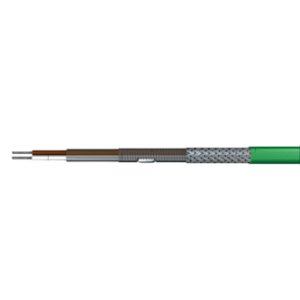
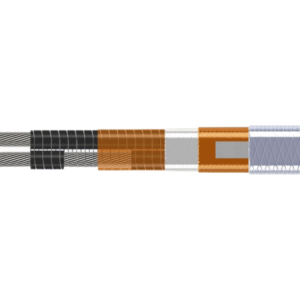
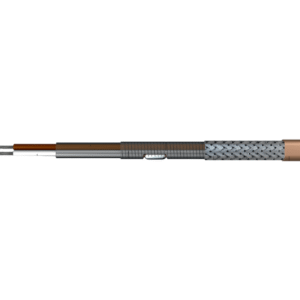
Constant wattage heating cable delivers a fixed heat output along its entire length, regardless of the surrounding temperature. Unlike self-regulating cable, it doesn’t throttle its own output as conditions change — the wattage per meter stays the same whether the pipe is at -10°C or +40°C, which makes external temperature control the responsibility of a separate thermostat or controller rather than the cable itself.
The cable’s heating element is a fixed-resistance conductor — the same working principle as a standard electric heating element — that dissipates a set wattage per unit length whenever current flows through it. Because the resistance doesn’t change with temperature the way a self-regulating cable’s carbon-black polymer core does, the heat output stays constant regardless of ambient conditions. This is precisely why constant wattage systems require a thermostat, temperature controller, or high-limit cutout: without one, the cable will keep outputting the same heat even once the process has already reached its target temperature, risking overheating on insulated or blocked sections.
Two circuit types cover different installation needs:
Typical watt density for constant wattage cable runs roughly 5–40 W/m, depending on the wire’s resistance and the supply voltage — on the higher end of what most self-regulating cables offer at a comparable temperature, which is part of why constant wattage suits higher continuous-temperature process lines better.
Constant wattage cable is the more straightforward choice for long, uniform pipe runs at a single, well-defined temperature target, where a controller is already part of the design and the extra cost or complexity of self-limiting behavior isn’t needed. It’s commonly specified for long pipelines, process lines, equipment heating, vessels, and hazardous-area freeze protection — installations where the run doesn’t pass through a wide mix of insulated and exposed sections that would otherwise cause a self-regulating cable’s output to vary unpredictably along its length. It’s also typically the lower-cost option upfront, which is part of why it remains common on long, well-defined runs where the design already accounts for a controller.
Self-regulating cable remains the better fit where the run has inconsistent insulation, variable ambient exposure, or a need to avoid overheating without relying on a separate controller.
Paklink’s constant wattage range spans 200°C, 260°C, and 280°C-rated variants, covering standard process heating through higher-temperature industrial requirements. Because output is fixed rather than self-limiting, correct sizing at the design stage matters more than it does for self-regulating cable — watt density has to be calculated against the pipe’s actual heat loss (driven by pipe diameter, insulation thickness, and minimum ambient temperature) rather than left to the cable’s own throttling behavior to compensate for an oversized estimate.
A temperature controller with a high-limit cutout is standard practice on constant wattage circuits, and ground-fault protection on the branch circuit is required by most electrical codes, the same as on self-regulating installations.
Constant wattage heating cable is used for long pipelines, process temperature maintenance, equipment and vessel heating, and outdoor installations, and integrates readily with industrial automation and control systems where a centralized controller is already managing setpoints. It’s a common choice across oil & gas, industrial manufacturing, and infrastructure projects wherever the run length and consistent target temperature favor a fixed-output design over a self-limiting one.
Paklink LLC supplies series and parallel constant wattage heating cables, including high-temperature and industrial-grade variants rated to 280°C, for long pipelines, process lines, equipment heating, and vessel applications across UAE, Qatar, Bahrain, Saudi Arabia, Egypt, Kazakhstan, Oman, Russia, Kuwait, Sudan, Iraq, Turkey, and Yemen. Paklink’s technical team supports circuit type selection, sizing, and controller integration from specification through project completion.
Does constant wattage cable need a thermostat?
Yes — unlike self-regulating cable, constant wattage cable doesn’t reduce its own output as temperature rises, so a thermostat or temperature controller with a high-limit cutout is standard practice to prevent overheating.
Can constant wattage cable be cut to length on site?
It depends on the type. Parallel constant wattage cable can be cut to length, since each heating segment functions independently. Series constant wattage cable cannot — it’s manufactured to an exact factory-set circuit length and must be ordered accordingly.
Which is better: constant wattage or self-regulating cable?
Neither is universally better — they suit different runs. Constant wattage fits long, uniform runs at a single target temperature where a controller is already part of the design. Self-regulating fits runs with variable insulation or ambient exposure, where throttling output locally avoids overheating without extra control hardware.
What temperature ranges does Paklink’s constant wattage range cover?
200°C, 260°C, and 280°C-rated variants, covering standard process heating through higher-temperature industrial requirements.
What happens if a fault develops on a constant wattage circuit?
On series constant wattage cable, a fault anywhere along the circuit takes down the entire run, since the cable is one continuous resistive element — there’s no way to isolate just the affected section. Parallel constant wattage cable is more fault-tolerant: because each segment operates as its own independent circuit, a fault in one section doesn’t necessarily disable the rest of the run.