Showing 1–16 of 18 results
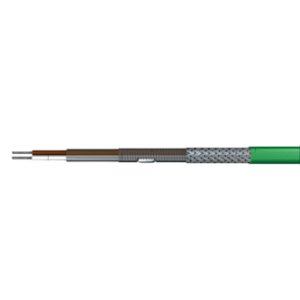
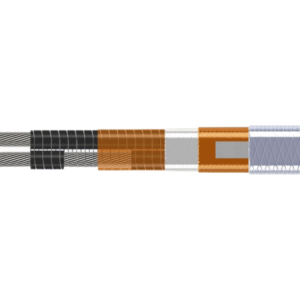
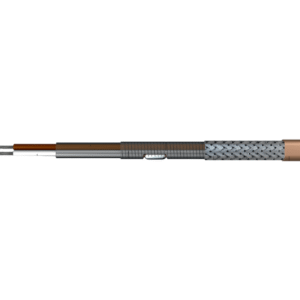


Heat trace cable — also called electric heat tracing or heat tape — is an electrical cable that runs alongside or wrapped around a pipe, tank, or vessel to maintain or raise its temperature. It replaces older steam-tracing systems on most new industrial installations, since it needs no steam supply infrastructure, is simpler to install and maintain, and can be controlled per-circuit rather than as part of a shared steam network.
Every heat trace cable does the same basic job — convert electrical current into heat along a pipe run — but the three main constructions differ in exactly how they do it, what temperature range they can sustain, and what installation conditions they’re each built for.
Self-regulating cable automatically varies its heat output along its length in response to local temperature, using a conductive polymer core with a positive temperature coefficient of resistance. It needs no thermostat to avoid overheating and handles continuous temperatures up to roughly 210°C. It’s the most forgiving option to install on runs with uneven insulation or variable ambient exposure.
Constant wattage cable outputs a fixed wattage per unit length regardless of temperature, and requires a thermostat or controller to prevent overheating once the target temperature is reached. It comes in series (factory-length only) and parallel (field-cuttable) circuit types, and typically costs less upfront than self-regulating cable for long, uniform runs at a single target temperature.
Mineral insulated (MI) cable uses a metal-sheathed, magnesium-oxide-insulated construction rather than an organic polymer jacket, which lets it sustain continuous temperatures from 400°C up to 600°C — well beyond what either of the other two types can handle. It also requires a thermostat (its resistance element behaves electrically like constant wattage cable) and needs more careful termination, since its MgO insulation is moisture-sensitive.
A smaller set of specialized cables — such as ceramic-device heat trace cable rated up to 600°C for glass, quartz, and dry-environment applications — cover use cases outside these three standard categories; these are typically selected in direct consultation with a project engineer rather than off a general comparison table.
Three questions, in order, narrow the choice quickly:
1. What’s the maximum continuous process temperature?
Below roughly 210°C, self-regulating or constant wattage both work — the decision comes down to installation conditions (question 2). Above 210°C but below 900°C, mineral insulated cable is generally required, since organic-insulated cable (self-regulating or constant wattage) isn’t rated for continuous service in that range.
2. Does the run have uneven insulation or variable ambient exposure?
If yes, self-regulating cable’s ability to throttle output independently at every point along its length avoids both cold spots and overheating risk without extra control hardware. If the run is uniform and a controller is already part of the design, constant wattage is simpler and cheaper.
3. Is the site corrosive, high-moisture, or otherwise physically demanding?
Mineral insulated cable’s metal sheath handles conditions — chemical exposure, mechanical stress, sustained high humidity alongside high temperature — that would degrade an organic-insulated cable’s jacket over time, even within that cable’s rated temperature range.
Heat trace cable, across all three types, is used for freeze protection, process temperature maintenance, and equipment heating on pipes, tanks, and vessels in oil & gas, petrochemical, industrial manufacturing, marine, and infrastructure projects. Specific applications range from long pipeline freeze protection and cryogenic-facility structural heating to roof and gutter de-icing and hot-water temperature maintenance — the right cable type depends on the temperature range and site conditions described above, not the application alone.
Paklink LLC supplies the full range of heat trace cable — self-regulating, constant wattage, and mineral insulated — for freeze protection and process temperature maintenance across UAE, Qatar, Bahrain, Saudi Arabia, Egypt, Kazakhstan, Oman, Russia, Kuwait, Sudan, Iraq, Turkey, and Yemen. Paklink’s technical team supports cable-type selection, circuit sizing, and installation guidance from specification through project completion.
What’s the difference between heat trace cable and heat tape?
They’re the same thing — “heat tape” is the more common term in residential and light-commercial contexts, while “heat trace cable” is the standard industrial and engineering term. Both refer to electrical cable run along a pipe to maintain or raise its temperature.
Which type of heat trace cable is cheapest?
Constant wattage cable is typically the lowest upfront cost of the three, followed by self-regulating cable, with mineral insulated cable the most expensive due to its metal-sheathed construction and higher-temperature capability. Total installed cost depends heavily on circuit length, controller requirements, and site conditions, not just the cable price itself.
Can I mix cable types on the same project?
Yes — this is standard practice. A project might use self-regulating cable on freeze-protection runs, constant wattage on long uniform process lines, and mineral insulated cable on high-temperature sections, each selected for the specific conditions of that circuit rather than standardizing on one type across the whole site.
Does heat trace cable replace steam tracing?
On most new installations, yes. Electric heat trace cable needs no steam supply infrastructure, is controlled per-circuit rather than as part of a shared steam network, and is generally simpler to install and maintain — though steam tracing can still be the better fit where a facility already has extensive steam infrastructure in place.