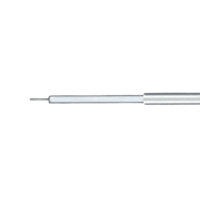
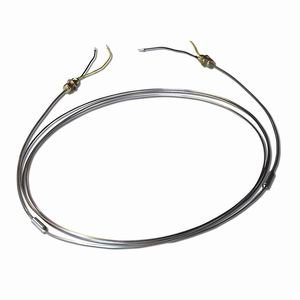
Mineral insulated (MI) heating cable is a metal-sheathed heat trace cable built for continuous high-temperature and corrosive-environment service beyond what organic-insulated cables — self-regulating or constant wattage — can sustain. Where standard organic-insulated cable typically tops out around 260°C, MI cable’s inorganic construction handles continuous exposure from 400°C up to 900°C, depending on the specific product rating.
MI cable consists of a copper resistance-heating conductor embedded in highly compacted magnesium oxide (MgO) insulation, entirely enclosed in a metal sheath — typically nickel-chromium Alloy 825 or stainless steel. Each layer does a specific job: the MgO provides electrical insulation while conducting heat efficiently outward to the sheath, and the metal sheath gives the cable its mechanical strength, chemical resistance, and continuous-service temperature capability. The nickel-chromium Alloy 825 sheath specifically resists stress corrosion in chloride, salt, and acidic environments, which is why it’s the standard choice for coastal and marine-adjacent industrial sites.
Electrically, MI cable behaves like constant wattage cable — the resistance element outputs a fixed wattage per unit length regardless of ambient temperature, so a thermostat or temperature controller is standard practice to manage the circuit rather than relying on the cable to self-limit. A single MI cable circuit can trace pipe runs extending well over a kilometer from one power supply point, which reduces the number of separate power feed points needed on long pipeline sections.
MI cable’s magnesium oxide insulation is hygroscopic — it readily absorbs moisture from the atmosphere if the sheath or termination is compromised. This makes correct termination the single most critical step in an MI cable installation: every termination point must be sealed against moisture ingress, using either a pot seal (a sealing compound encapsulating the exposed MgO and conductor tails) or a compression gland fitting. If a seal fails, moisture enters the MgO, insulation resistance drops, and the circuit can fail insulation-resistance testing or trip ground-fault protection.
Two other installation details matter in practice:
Ground-fault protection on the branch circuit is required by most electrical codes, the same as on self-regulating and constant wattage installations, since a damaged sheath is the primary fault mode to guard against.
MI cable is the right choice once a process temperature requirement exceeds what self-regulating cable’s polymer core (roughly 210°C continuous) or standard constant wattage cable can reliably sustain, or where the installation faces corrosive, high-moisture, or physically demanding conditions the other two constructions aren’t built for. It’s the standard specification for high-temperature process lines, cryogenic storage tank heating (heating the surrounding structure rather than the cryogenic contents), power plant equipment, and long pipeline runs in petrochemical and refining environments with classified hazardous areas.
Self-regulating and constant wattage cable remain the more economical choice below roughly 260°C, where MI cable’s higher cost and more demanding termination requirements aren’t necessary.
Mineral insulated heating cable is used for high-temperature process pipeline maintenance, vessel and tank heating, cryogenic storage facility structural heating, power plant and refinery equipment, and long-distance pipeline runs where a single circuit needs to cover extended distances from one power feed point. It’s the standard specification across oil & gas, petrochemical, and LNG processing facilities wherever process temperatures or corrosive site conditions exceed what organic-insulated cable can handle continuously.
Paklink LLC supplies mineral insulated heating cable rated from 400°C to 600°C, including a dedicated valve and pipe heating variant rated to 450°C, for high-temperature process lines, vessel heating, and long pipeline runs across UAE, Qatar, Bahrain, Saudi Arabia, Egypt, Kazakhstan, Oman, Russia, Kuwait, Sudan, Iraq, Turkey, and Yemen. Paklink’s technical team supports sheath material selection, termination guidance, and circuit sizing from specification through project completion.
What’s the maximum temperature mineral insulated cable can handle?
Depending on the specific product and sheath material, MI cable handles continuous exposure from 400°C up to 900°C. Paklink’s range covers 400°C and 600°C standard ratings, up to 900°C for the most extreme process requirements, plus a dedicated valve and pipe heating variant rated to 450°C.
Why does mineral insulated cable need special termination sealing?
Its magnesium oxide insulation is hygroscopic — it absorbs moisture readily if exposed. An unsealed or poorly sealed termination lets moisture into the MgO, which drops insulation resistance and can cause the circuit to fail insulation testing or trip ground-fault protection. Terminations are sealed with either a pot seal or a compression gland to prevent this.
Does mineral insulated cable need a thermostat, like constant wattage cable?
Yes. MI cable’s resistance element produces a fixed wattage per unit length regardless of temperature, the same electrical behavior as constant wattage cable, so a thermostat or temperature controller is standard practice to manage the circuit.
When should I choose mineral insulated cable over self-regulating or constant wattage?
Once the process temperature requirement exceeds what organic-insulated cable can sustain continuously (roughly 260°C), or where the site has corrosive, high-moisture, or physically demanding conditions — mineral insulated cable’s metal sheath and inorganic insulation handle both far better than either alternative.