
Description
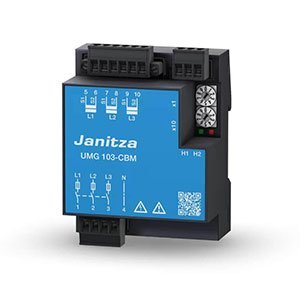
Janitza UMG 103-CBM Compact Energy Analyzer
The Janitza UMG 103-CBM is a compact energy analyzer for measuring electrical quantities in low-voltage distribution boards, circuit breakers, and busbar trunking systems. It measures voltage, current, power, energy, and harmonics in three-phase four-conductor networks with nominal voltages up to 277 V line-to-neutral and 480 V line-to-line. The analyzer mounts on a 35 mm DIN rail in a width of four modules, and it is part of Janitza’s energy management range.
The device has no display. It reports through two status LEDs and through its RS-485 interface, so its measurements are read by a PLC, a building management system, a SCADA platform, or the Janitza GridVis software. This design keeps the instrument small and suits distribution boards where values are collected remotely rather than read at the panel.
Key Features
- Three voltage measurement inputs (300 V, CAT III) and three current measurement inputs for external current transformers
- Current transformer ratios of ../1 A and ../5 A, with a measuring range of 0.005 to 6 A
- True RMS (TRMS) measurement with a 5.4 kHz sampling frequency
- Active energy measurement uncertainty class 0.5S with ../5 A transformers
- Harmonic analysis from the 1st to the 40th order for voltage and current, with THD values
- Measurement of positive, negative, and zero sequence components
- 4 MB flash memory with a real-time clock and battery for time-stamped recording
- RS-485 interface with Modbus RTU slave protocol and automatic baud rate detection
- Device address set with two rotary coding switches from 01 to 99
- Self-powered from the measured voltage
- Compact housing, 71.5 x 98 x 46 mm, approximately 200 g
What the UMG 103-CBM Measures
The analyzer measures voltage and current continuously and calculates all effective values in a 200 ms interval. From these it derives active, reactive, and apparent power for each phase and as a sum, the power factor, frequency, and the active, reactive, and apparent energy counters, including energy delivered to and drawn from the network. It also reports the neutral conductor current as a calculated value and the direction of the rotary field.
Accuracy follows the IEC 61557-12 performance classes. Voltage is measured to class 0.2, phase current and active power to class 0.5, and reactive power to class 1. Active energy meets class 0.5S under IEC 62053-22 when ../5 A current transformers are used, and class 1 with ../1 A transformers. The specified accuracy applies after a 10-minute warm-up at an ambient temperature of 18 to 28 degrees Celsius.
Harmonics and Network Quality Indicators
Harmonics are multiples of the 50 or 60 Hz fundamental frequency that distort the voltage and current waveforms. They come mainly from non-linear loads such as variable frequency drives, LED drivers, and switch-mode power supplies. The UMG 103-CBM analyzes voltage and current harmonics from the 1st to the 40th order and calculates total harmonic distortion for both. These values let an engineer see whether a distribution board is carrying significant distortion before it causes heating in cables and transformers or disturbs sensitive equipment.
Powering and Connecting the Device
The UMG 103-CBM takes its supply from the measured voltage, so it needs no separate auxiliary supply. A single phase of 115 to 277 V or three phases of 80 to 277 V power the device, with a maximum consumption of 1.5 VA. The device bridges mains failures of up to 80 ms at 230 V AC.
Current is measured only through external current transformers, because the device does not measure direct current and has no direct current input. The transformers must be intended for measurement rather than protection, and their secondary circuits must never be opened while the primary carries current. The measured voltages and currents must originate from the same network. The analyzer is not intended for critical switching, control, or protective relay functions.
Recording Data and Monitoring Limits
The device records measurements on its own, so a permanent connection to a computer is not required. Its 4 MB flash memory and battery-backed clock store time-stamped data. The standard configuration contains two recording profiles, one logging voltages, currents, power, and power factor at 15-minute intervals and one logging energy values hourly, and both can be changed in GridVis. The shortest recording interval is one minute, and a maximum of four recordings with 29 measured values each can be configured.
The drag indicator function keeps the three highest average values of current, active power, and apparent power over a configurable time base, which helps identify peak demand. Two comparator groups, each with three comparators, monitor limit values and can be combined with AND or OR logic. The comparator results are available through Modbus.
Communication and Configuration
The RS-485 interface uses the Modbus RTU protocol as a slave and supports transmission rates of 9.6, 19.2, 38.4, 57.6, and 115.2 kbps with automatic detection. One bus segment can hold up to 32 devices, and the cable can reach 1,200 m at 38.4 kbps. The bus must be terminated with 120 ohm resistors at both ends, because the device has no integrated termination.
The UMG 103-CBM has no built-in Ethernet port. A PC with GridVis connects through an RS-485 to USB or RS-232 converter, and several UMG 103-CBM units can connect to Ethernet through a master device with gateway functions, such as the Janitza UMG 604-PRO. The GridVis software configures the device, sets the current and voltage transformer ratios, reads the data, updates the firmware, and creates reports. The green and red LEDs on the front show operating status, data transmission, and error conditions.
Technical Specifications at a Glance
| Parameter | Value |
|---|---|
| Mounting | 35 mm DIN rail, 4 modules |
| Dimensions (W x H x D) | 71.5 x 98 x 46 mm |
| Weight | Approx. 200 g |
| Voltage inputs | 3, 300 V CAT III; up to 277 V L-N / 480 V L-L |
| Current inputs | 3, via ../1 A or ../5 A transformers; 0.005 to 6 A |
| Supply | Self-powered from measured voltage, max. 1.5 VA |
| Active energy class | 0.5S (../5 A), class 1 (../1 A) |
| Harmonics | 1st to 40th order, voltage and current |
| Memory | 4 MB flash |
| Interface | RS-485, Modbus RTU slave |
| Operating temperature | -25 to +60 degrees Celsius |
| Protection | IP20, protection class II |
Where the UMG 103-CBM Is Used
- Distribution boards and switchgear: circuit-level energy and demand monitoring inside low-voltage boards
- Busbar trunking systems: measurement at tap-off units to allocate consumption to individual feeders
- Commercial and office buildings: sub-metering of floors, tenants, or HVAC plant for cost allocation, read by a building management system over Modbus
- Industrial plants: monitoring of machine groups and production lines to find where energy is used
- Retrofit metering: adding measurement to an existing board, because the DIN-rail format and self-powered design need few connections
- Energy management programs: collecting baseline consumption data for efficiency projects and reporting
The device is intended for indoor, weather-protected installation in switch cabinets and small distribution boards. It is not designed for environments with harmful oils, acids, gases, vapors, or dust.
Choosing Between Janitza Meters
The UMG 103-CBM suits distribution boards where measurements are read remotely. Meters in the front-panel format, such as the UMG 96 family, provide local readout, and the Janitza UMG 512-PRO provides Class A power quality analysis under IEC 61000-4-30 where disturbances such as voltage dips and transients need to be recorded.
Sourcing the UMG 103-CBM Regionally
Paklink LLC supplies the Janitza UMG 103-CBM compact energy analyzer across UAE, Qatar, Bahrain, Saudi Arabia, Egypt, Kazakhstan, Oman, Russia, Kuwait, Sudan, Iraq, Turkey, and Yemen, with technical support for metering design, current transformer selection, and Modbus integration.
Frequently Asked Questions
Does the UMG 103-CBM have a display?
No. It reports through two status LEDs and its RS-485 interface. Measured values are read with a PLC, a building management system, or the GridVis software.
Can the UMG 103-CBM connect to Ethernet directly?
No. It has an RS-485 Modbus RTU interface only. It can reach an Ethernet network through a master device with gateway functions, such as the Janitza UMG 604-PRO.
Does the UMG 103-CBM need a separate power supply?
No. It obtains its supply from the measured voltage, either from one phase of 115 to 277 V or from three phases of 80 to 277 V.
Which current transformers can be used?
Current transformers with secondary currents of ../1 A or ../5 A. They must be measurement transformers, not protection transformers.
How many harmonics does it analyze?
Voltage and current harmonics from the 1st to the 40th order, plus total harmonic distortion.


Reviews
There are no reviews yet.