
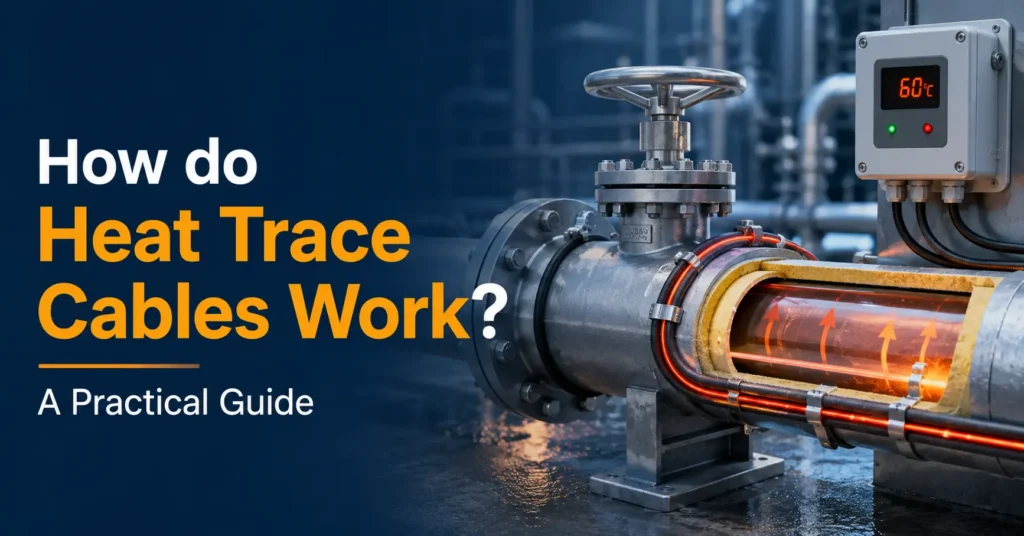
Ask most people how a heat trace cable works, and they’ll say “it’s just resistance heating” — which is true, but it skips the part that actually matters. Two cables can both run on electrical resistance and behave in completely different ways: one adjusts its own output constantly without any outside control, and the other delivers exactly the same heat whether the pipe is at -20°C or already warm. The difference isn’t the wiring. It’s what’s happening inside the cable at the material level.
For a full comparison of cable families with temperature ranges and cost tradeoffs, see our guide to major cable types. For full-system design — sizing, installation, and commissioning — see our complete guide to heat trace cables.
The Starting Point: Resistance Heating
Every heat trace cable relies on the same basic principle — pass current through a material with electrical resistance, and that resistance converts electrical energy into heat. That heat transfers into whatever the cable is touching: a pipe wall, a tank surface, an instrument line. Insulation wrapped around the assembly then slows how fast that heat escapes back into the surrounding air.
That much is common to every cable type on the market. Where they diverge is in what generates the resistance, and whether that resistance changes on its own.
Inside a Self-Regulating Cable: How PTC Polymer Actually Works
Self-regulating cable was invented in 1972, and the breakthrough wasn’t really about heating — it was a materials science problem. Traditional heaters up to that point ran as series circuits, meaning the entire cable’s resistance had to be precisely determined and built at the factory. Cut a series-circuit cable to the wrong length on site, and its heat output changed unpredictably, or the cable simply failed.
The fix was a conductive polymer core built from a semi-crystalline plastic matrix packed with billions of microscopic carbon black particles, extruded between two parallel copper bus wires running the cable’s full length. This is genuinely a parallel circuit design, not a series one — which is the reason self-regulating cable can be cut to any length in the field without changing how it behaves.
Here’s the mechanism that gives the cable its name: at lower temperatures, the carbon particles in the polymer sit close together, forming continuous conductive pathways that let current flow freely and generate significant heat. As the surrounding temperature rises, the polymer matrix physically expands, pulling those carbon particles apart and breaking many of the conductive paths. Resistance rises sharply, current drops, and heat output falls — all without a thermostat, sensor, or any external control involved. When the surface cools again, the polymer contracts, the carbon network reconnects, and heat output climbs back up. This is a genuine material property called a Positive Temperature Coefficient (PTC), and it happens independently, continuously, at every single point along the cable’s length — which is really the core idea: each inch of a self-regulating cable is effectively running its own thermostat, reacting only to what it’s touching.
One manufacturing detail matters more than it might seem: the polymer needs to be radiation cross-linked during production, which chemically bonds the polymer chains so the material reliably returns to its original density every time it cools. Without that step, the PTC effect would degrade with repeated heating and cooling cycles rather than staying consistent over years of service.
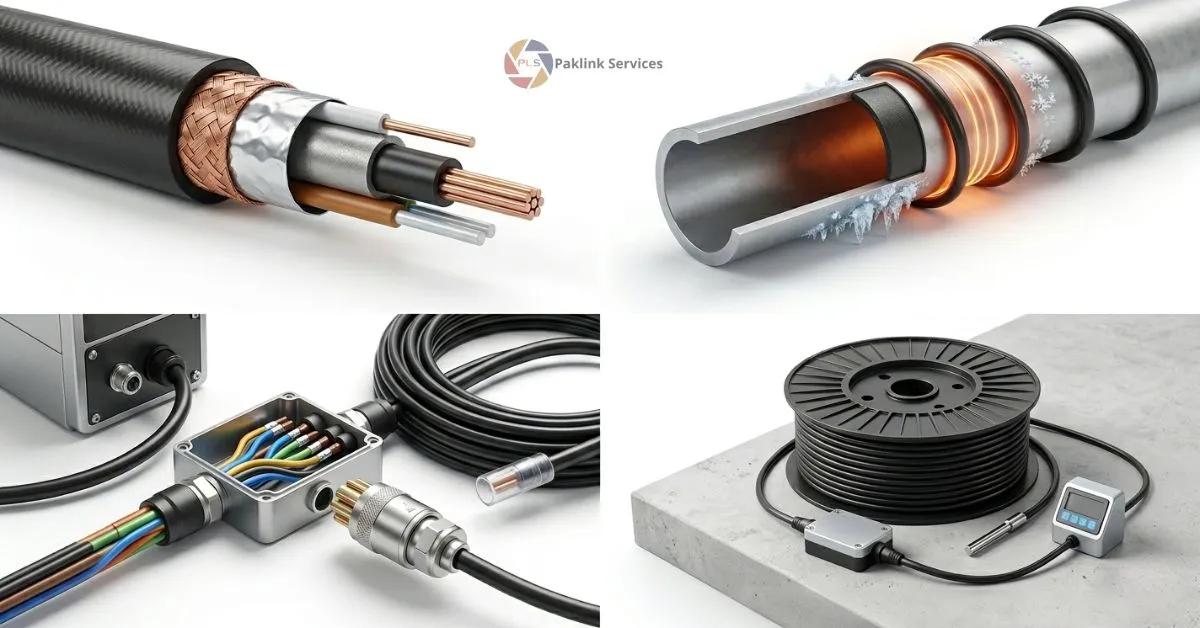
A typical self-regulating cable, built from the inside out:
- Two tinned copper bus wires carrying current along the full length
- The conductive polymer core — the PTC element itself
- A polyolefin or fluoropolymer inner jacket for electrical insulation
- A metal braid (tinned copper or stainless steel) for mechanical protection, grounding, and shielding
- An outer jacket selected for chemical resistance, UV stability, or hazardous-area compliance depending on where it’s installed
Constant Wattage Cable: The Series-Circuit Alternative
Constant wattage cable takes the older, simpler approach that self-regulating cable was originally invented to improve on. It runs as a series circuit, with a fixed resistance element built to a specific factory length and wattage rating. There’s no PTC material, no self-adjustment — the cable delivers the wattage it was built to deliver, for as long as it’s powered, regardless of ambient temperature.
That fixed behavior is a real tradeoff both ways. It’s genuinely more cost-effective per meter, and its output is completely predictable, which simplifies sizing math on long, uniform runs. But because it can’t self-limit, overlapping or bunching constant-wattage cable creates a real overheating risk that self-regulating cable simply doesn’t have — control has to come entirely from an external thermostat, since the cable itself has no built-in ceiling.
Where Mineral-Insulated Cable Fits
Mineral-insulated cable uses a different construction entirely — a metal sheath packed with compressed mineral insulation rather than a polymer core — which is what gives it a much higher temperature ceiling and better chemical resistance than either self-regulating or constant wattage cable. It behaves like constant wattage cable in the sense that output doesn’t self-adjust, but its construction is built specifically for conditions where a polymer-based cable, self-regulating or not, wouldn’t survive. See the cable types guide for a full breakdown of where each construction earns its cost.
Sizing and Selection Checklist
Understanding the mechanism matters because it changes what you need to plan for. A short list of inputs prevents most sizing mistakes before they happen:
- Set the goal: freeze protection or temperature maintenance
- Note the lowest outdoor temperature the site will see
- Record pipe size, pipe material, and total run length
- Count valves, flanges, supports, and branch points
- Choose insulation type and thickness early in the process
- Check voltage, breaker size, and circuit limits against the design
- Confirm site rules for ordinary versus hazardous-area classification
Selection Reference Table
| Input | Why it matters | Example |
|---|---|---|
| Lowest ambient temp | Sets worst-case heat loss | -10°C winter nights |
| Pipe size and material | Changes heat loss and contact area | 2″ steel pipe |
| Fluid type | Sets the target temperature | Water, diesel, syrup |
| Insulation thickness | Cuts heat loss and power use | 25mm vs 50mm |
| Wind and rain exposure | Raises heat loss | Coastal rooftop |
| Control method | Limits heat, saves energy | Thermostat + sensor |
| Site rules | Drives approvals and hardware | Hazardous-area rating |
Control Options
| Control style | What it does | Where it fits |
|---|---|---|
| Ambient thermostat | Switches heat based on air temperature | Basic freeze protection |
| Line-sensing thermostat | Controls heat using pipe temperature directly | Temperature maintenance |
| Electronic controller | Adds tighter control bands and alarms | Industrial and critical lines |
| Networked panels | Monitor multiple circuits and log trend data | Large plants and multi-zone sites |
Note that self-regulating cable’s built-in PTC behavior reduces how much external control complexity is needed — it’s already doing part of the job the controller would otherwise have to manage entirely on constant wattage or MI cable.
Final Takeaway
The mechanism inside the cable isn’t just a technical curiosity — it directly determines what the cable can and can’t do on your site. A parallel-circuit PTC cable adapts to conditions and tolerates field cutting; a series-circuit constant wattage cable delivers precise, predictable heat but needs external control and careful spacing to stay safe. Picking between them starts with understanding which behavior your application actually needs.
FAQs
Why can self-regulating cable be cut to length on site, but not all cable types?
Self-regulating cable uses a parallel circuit design — each section of the conductive polymer core operates independently, so cutting the cable doesn’t change how the remaining sections behave. Series-circuit cable types, like constant wattage cable, have resistance calculated for a specific factory length; cutting them changes the circuit’s electrical characteristics unpredictably.
What actually causes self-regulating cable to reduce its own heat output?
A material property called Positive Temperature Coefficient (PTC): the conductive polymer core expands as it warms, physically separating the carbon particles that form its conductive pathways. That raises electrical resistance, which reduces current flow and heat output — a real physical reaction, not an electronic control system.
Does self-regulating cable ever fully turn off?
Not completely — as it approaches a high enough temperature, resistance rises sharply and heat output drops close to zero, but the effect is continuous and reversible rather than an on/off switch. It responds again as soon as the surface cools.
Why does constant wattage cable need external control if self-regulating doesn’t?
Because constant wattage cable has no built-in mechanism to reduce its own output — it delivers the same wattage regardless of temperature unless something else, like a thermostat, physically interrupts the circuit.
Is PTC technology only used in heat trace cable?
No — PTC materials are used across a range of electrical devices as self-limiting heating and protection elements, but their large-scale application to trace heating dates to the early 1970s, when the parallel-circuit, field-cuttable design was first developed specifically to solve the length and overheating limitations of series-circuit heaters.