
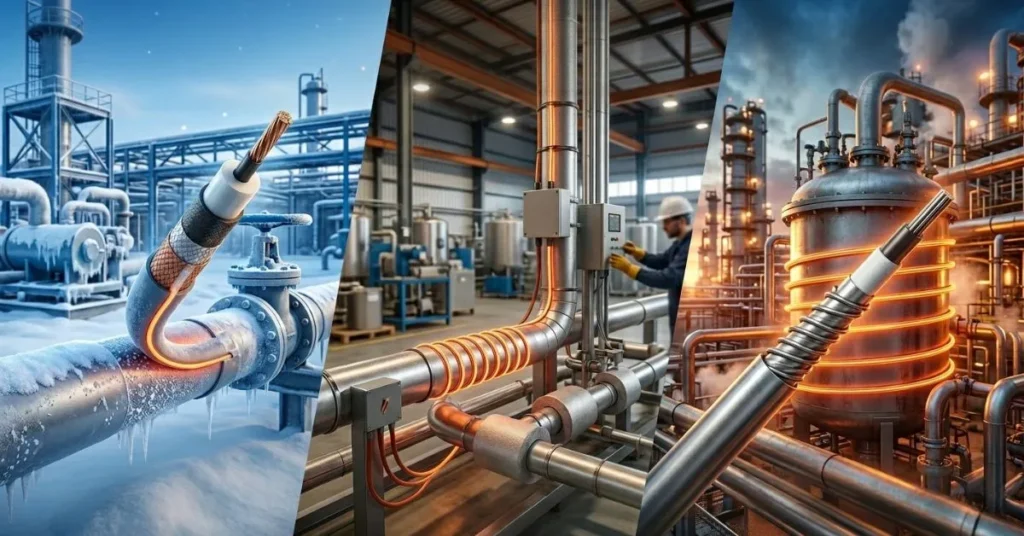
Cold weather and extended shutdowns create real operational problems: pipes freeze, fluids thicken past their working viscosity, and valves seize. Heat trace cable solves this by adding steady, controlled heat along pipes, tanks, and instrumentation — protecting flow, supporting safety, and cutting the time needed to restart a cold system.
But “heat trace cable” isn’t one product. It’s several genuinely different technologies, each built for a different combination of temperature range, circuit length, hazard classification, and budget. Get the choice wrong, and the consequences aren’t just financial — a mismatched cable can mean hot spots, premature failure, or a system that simply can’t hold the temperature it was specified for. This guide walks through each type in depth, so the decision can be made before a single component gets priced.
For a broader walkthrough of full-system design — sizing formulas, installation steps, and commissioning — see our complete guide to heat trace cables.
Most Common Heat Trace Cables
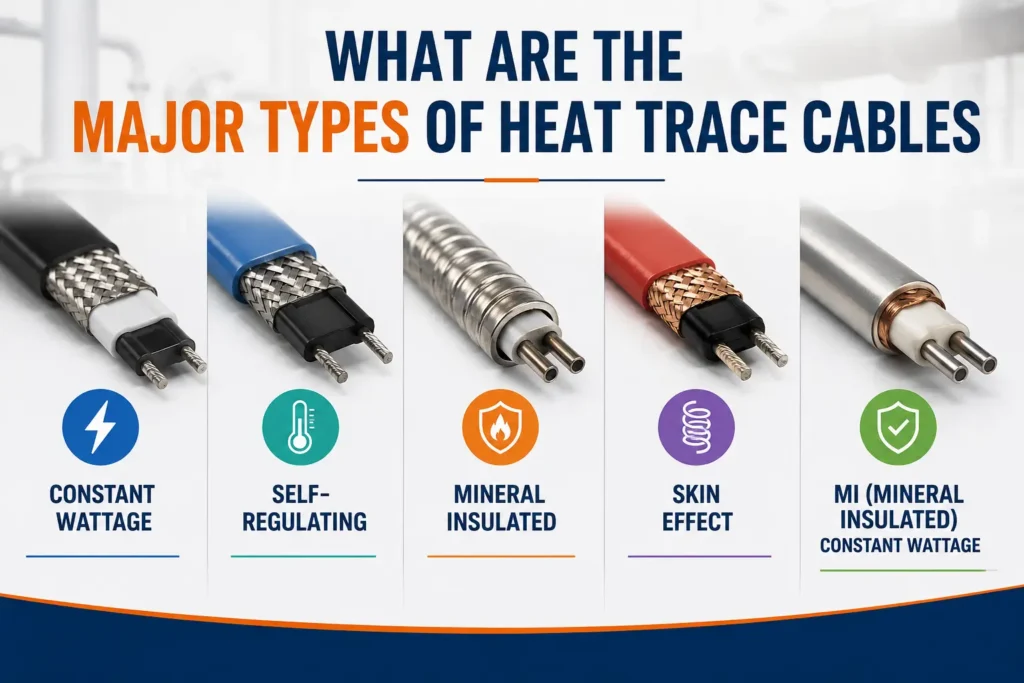
Self-Regulating Cable
Of the cable families, self regulating cable is the one that thinks for itself. Its core adjusts heat output continuously along the run, pulling more power over a cold section and less over a warm one — no external logic required, just the cable responding to what it’s touching.
That behavior spans a real temperature range in practice. Lower-rated variants, good to around 80°C, cover standard freeze protection and general water-line maintenance. Higher-rated versions, going up to roughly 210°C, handle more demanding industrial tracing. There are also purpose-built variants for specific jobs — one designed specifically for ramp and surface ice protection, others tuned for hot-water or portable-water applications at more moderate temperatures.
That built-in responsiveness pays off in energy terms — the cable never draws more than the local conditions call for — and it resists overheating almost by design, since output falls as the pipe warms. It’s also considered safe for direct use on plastic piping, which rules it in for applications where a fixed-output cable would be a risk.
The tradeoff shows up mainly in upfront cost, which runs higher than series or constant wattage cable of similar length, and in gradual output degradation over its service life — a factor worth building into long-term sizing rather than discovering later.
Where it earns its cost is on runs where conditions genuinely vary from one end to the other: a shaded section next to a sun-exposed one, mixed pipe diameters, or general freeze protection where the whole point is adapting to whatever the weather does.
Constant Wattage Cable
Constant wattage cable takes the opposite approach — one fixed wattage per meter, delivered the same way regardless of ambient temperature, with an external thermostat or controller doing the on/off cycling instead of the cable itself.
This family typically covers a 200–280°C range, which sits it comfortably below mineral-insulated cable in temperature ceiling but well above what most self-regulating variants handle. The appeal here is predictability. Because output never varies, sizing calculations stay straightforward, and the cable itself typically costs less than self-regulating cable. On long, uniform pipeline runs and storage tank heating — anywhere the whole circuit sees roughly the same conditions — that consistency is exactly what’s needed.
It does demand more care during installation, though. Without self-limiting behavior, overlapped or bunched cable can develop hot spots, so spacing has to be right the first time. And because the cable can’t respond to local conditions on its own, an external control strategy becomes a required part of the design rather than an optional add-on.
Mineral-Insulated (MI) Cable
MI cable is built differently at the physical level — a metal sheath packed tight with compressed mineral insulation around the conductor. That construction pushes its temperature ceiling and chemical resistance well past what any polymer-jacketed cable can handle, with ratings that run as high as 600°C depending on the specific grade.
Refineries and petrochemical plants gravitate toward MI cable for exactly this reason: it shrugs off chemical exposure and mechanical abuse that would degrade other cable types, and once installed, it runs for years with comparatively little maintenance. Its rugged, inorganic construction also makes it a strong fit for hazardous-area classification.
None of that comes cheap. MI cable carries the highest material cost of the common families, and its stiffness adds real labor time during installation — it doesn’t route as flexibly as lighter cable. Field repairs are less forgiving too, requiring specialized termination kits and technicians trained specifically on MI splicing rather than general cable work.
The calculation that makes MI cable worthwhile: high-temperature or hazardous-area applications where reliability under extreme conditions matters more than what the cable costs to buy and install.
Series Resistance Cable
Series cable delivers heat at a fixed rate along its length, using a single continuous heating element that carries the full circuit — no variation by position or temperature, which keeps the design simple and the failure modes predictable.
What surprises a lot of people is how wide a temperature range this family actually spans — from around 200°C at the simpler end up to 900°C for the most heavy-duty variants, which makes series cable one of the broadest categories rather than strictly the “budget” option it’s often assumed to be. At the lower end, it remains genuinely cost-effective for straightforward, predictable heating needs: long pipeline runs, vessel heating, and roof or de-icing applications where a single power point needs to serve a long length reliably. At the extreme-temperature end, it competes directly with mineral-insulated cable for the most demanding valve and pipe heating jobs on a site.
What series cable can’t do is adapt. Any temperature variation along a run has to be solved through insulation and sensor placement rather than the cable adjusting itself, and unlike self-regulating cable, there’s no natural protection against localized overheating if a section gets bunched or covered unevenly.
Best for: applications spanning the full range from simple gutter and drain heating up to extreme-temperature valve and pipe work — the deciding factor is picking the right grade within the series family rather than choosing series cable itself as a category.
Skin-Effect and Power-Limiting Technologies
Two further heat trace technologies are worth understanding for very specific site conditions, even outside the standard cable families above.
Skin-effect systems concentrate current near the surface of a purpose-built heat-tube conductor, generating heat along pipeline runs that would be impractical to cover with standard resistance cable. A single power feed can carry a skin-effect circuit much further than a conventional cable run, which changes the economics on very long pipelines — large tank farms and wide industrial sites where a standard tracing circuit would otherwise need multiple separate power feeds. The tradeoff is engineering complexity: skin-effect systems need considerably more work around protection, grounding, and commissioning, plus specialized components and installation crews trained specifically on the technology.
Power-limiting cable behaves like constant-output cable at low temperatures, but automatically limits its own output once it crosses a set threshold — a self-limiting safety behavior without the continuous, gradual adjustment that true self-regulating cable performs. Engineers reach for it specifically where overheating risk is the primary design concern in hazardous-area applications.
Comparing the Range at a Glance
| Cable type | Adjusts to temperature? | Typical range | Best circuit length | Relative cost |
|---|---|---|---|---|
| Self-regulating | Yes, continuously | 80°C – 210°C | Long | Moderate–high |
| Constant wattage | No | 200°C – 280°C | Moderate | Moderate |
| Mineral-insulated | No | Up to 600°C | Very long | High |
| Series resistance | No | 200°C – 900°C | Short to very long, grade-dependent | Low to high, grade-dependent |
| Skin-effect | No (system-level) | Application-dependent | Very long (single feed) | High (engineering-heavy) |
| Power-limiting | Self-limiting above threshold | Application-dependent | Moderate | Moderate |
Matching a Cable to Your Site
Four factors decide which family fits: the temperature range the cable needs to survive and deliver, the chemical exposure it will face, the site’s area classification (ordinary versus hazardous), and the physical layout of the installation — pipe length, fitting density, and how accessible the run will be for future maintenance. Most industrial designs also reference IEEE 515, the standard governing testing, design, installation, and maintenance of electrical resistance heat tracing, to keep the selection and design process aligned with recognized practice.
The control side deserves equal attention. A basic thermostat handles wide temperature swings well enough; an electronic controller earns its cost on tighter control bands; PID control is for applications that genuinely need the tightest possible temperature stability and nothing less will do. Sensor placement matters just as much as the cable choice — on the pipe, under the insulation, away from direct sun and airflow drafts that would otherwise skew the reading.
A practical sequence for getting there:
- Define the goal — freeze protection or process temperature maintenance
- List every relevant temperature: normal operation, shutdown, upset conditions, and cleaning cycles
- Confirm area classification and required approvals for the zone
- Select the cable family — and specific grade — that matches both the exposure temperature and the installation layout
- Size the output using accurate heat-loss figures, then choose control style and protection devices to match
Once you’ve narrowed down the right family for your application, our full heat trace cable range covers the specific models and ratings available.
FAQs
Which cable type is cheapest to install overall?
At standard temperatures, series resistance cable tends to have the lowest cost, but total installed cost depends on run length, control requirements, and site complexity — and at the high-temperature end, series cable can cost as much as mineral-insulated cable rather than being the budget option.
What’s the highest-temperature cable technology available?
Series resistance cable, at its highest grade, reaches roughly 900°C — higher than standard mineral-insulated cable’s typical ceiling of around 600°C, which surprises people who assume MI cable is always the top-temperature choice.
Can different cable types be mixed across the same facility?
Yes, and it’s common practice — a site might specify mineral-insulated cable on high-temperature process lines, self-regulating cable for general freeze protection, and series cable on simple drain heating, each matched to what that specific run actually needs.
Does area classification limit which cable types are usable?
Yes. Hazardous-area zones require cable carrying the appropriate certification, which can rule certain options out regardless of how well they’d otherwise perform thermally. Confirm approvals for the specific zone before finalizing a selection.
Is series cable always the budget choice compared to self-regulating or MI cable?
Not necessarily. At standard temperatures it tends to be the lower-cost option, but the highest-temperature series cable grades serve the same extreme-temperature use cases as high-end MI cable, so cost comparisons should always be made grade-by-grade rather than category-by-category.
Do temperature ratings shift with cable age or installation quality?
Rated maximum temperatures assume correct installation and undamaged insulation — physical damage, incorrect spacing, or degraded jacketing can all reduce real-world performance below the manufacturer’s rated figure over time, which is part of why routine inspection matters as much as initial selection.