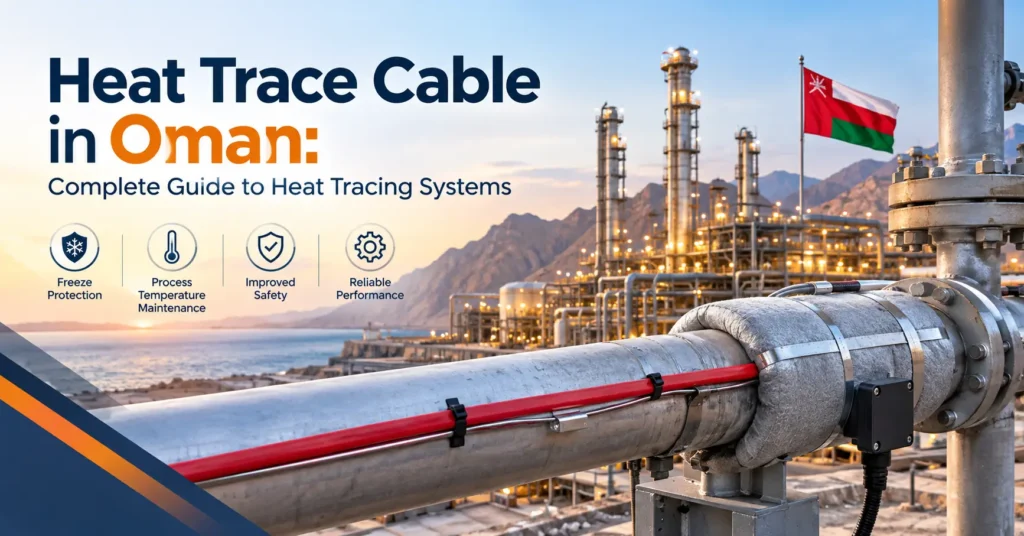
A heat trace cable in Oman is an electrical heating solution used to maintain the temperature of pipes, tanks, vessels, valves, instrument lines, and other industrial equipment. Heat tracing matters wherever a process needs a stable temperature, or where cooling would affect flow, viscosity, or reliability.
In Oman, this applies across oil and gas facilities (PDO, OQ, Oman LNG), the Sohar and Duqm refineries and free zones, Salalah Port, desalination plants, and industrial pipelines throughout the Sultanate’s process industries.
A complete heat tracing system is not just a heating cable — it involves the heating element, electrical supply, temperature control, sensors, insulation, accessories, circuit protection, and monitoring, sized to the process temperature, heat loss, pipe dimensions, insulation, ambient conditions, and installation environment.
What Is a Heat Trace Cable?
A heat trace cable (also called trace heating cable) is an electrical heating element run along a pipe, vessel, tank, valve, or instrument line. Current through the element produces controlled heat, which offsets thermal losses and keeps the process at its required temperature.
Heat tracing serves two broad purposes:
- Freeze protection — stopping a line from reaching a damaging low temperature.
- Temperature maintenance — holding a process fluid within a defined range, e.g., preventing a heavy fuel oil or chemical line from thickening.
In upstream operations, PDO specifications describe heat-traced sample supply and return lines used to keep analyzer sample temperatures within spec — a good example of how heat tracing sits inside the instrumentation system, not just the piping system.
How Does Heat Trace Cable Work?
Electrical energy → heating cable → controlled heat → temperature maintenance.
The heat required is set by how much heat the pipe or vessel is losing, which depends on:
- Pipe diameter, length, and material
- Process and ambient temperature
- Wind exposure
- Insulation material and thickness
- Required maintenance temperature
Worked example
A carbon steel pipe, DN100 (114 mm OD), carrying a process fluid that must stay above 60°C, insulated with 50 mm mineral wool, in a Duqm-area ambient of 15°C (winter night minimum) with light wind:
- Approximate heat loss: ~25–30 W/m at this insulation thickness and ΔT
- A self-regulating cable rated at 33 W/m (at 10°C) comfortably covers this loss with margin for insulation aging
- Circuit length and voltage drop are then checked against the cable’s maximum circuit length at the site’s supply voltage (commonly 230V single-phase or 400V three-phase for longer industrial circuits)
This is illustrative, not a substitute for a full heat-loss calculation — actual output selection should be verified against the manufacturer’s design tables and the pipe’s real operating envelope, including shutdown/standby conditions.
Why Is Heat Tracing Important in Oman?
Oman’s industrial base — PDO’s onshore fields, OQ’s refining and petrochemical assets, Oman LNG’s Qalhat facility, Sohar’s refinery and industrial port, and the Duqm Special Economic Zone — runs process lines where heat tracing is about process temperature control, not outdoor climate.
A line can need tracing even in a hot climate when:
- A fluid must stay above a viscosity or pour-point threshold
- A chemical or catalyst line has a narrow acceptable temperature band
- Analyzer or sample lines need controlled temperature to keep readings accurate
- A line must hold temperature during shutdown or standby, when there’s no process flow to carry heat
So the case for heat tracing in an Oman project comes from the process and thermal design, not from the outdoor forecast.
Main Types of Heat Trace Cable
| Cable type | Typical max temp | Best fit |
|---|---|---|
| Self-regulating | Up to ~210°C (e.g., Paklink’s ELSR-H range) | Pipes, valves, instrument lines, freeze protection |
| Constant wattage | Application-dependent, fixed W/m | Long circuits needing uniform, predictable output |
| Mineral insulated (MI) | Up to 400°C, and 600°C in select configurations | Refinery/petrochemical high-temp process lines |
| High-temperature | Above standard cable ratings | Specialized process duty — selected by actual thermal duty, not by application name |
Self-Regulating Heating Cable
Self-regulating cable adjusts its own heat output based on the surrounding temperature — more output where the pipe is colder, less where it’s warmer. Different sections of the same circuit respond independently to local conditions, which is useful on runs with mixed exposure (partly shaded, partly in direct sun).
Typical use: pipe freeze protection, water lines, process piping, valves, flanges, instrument lines, tanks.
Note: “self-regulating” doesn’t mean install-and-forget — exposure temperature, circuit length, voltage, and control still need engineering sign-off.
Constant Wattage Heat Trace Cable
Delivers a fixed heat output per metre along the circuit, useful where predictable heat delivery matters more than local self-adjustment — long pipelines, tank heating, utility lines. Wattage should be set from the calculated heat loss, not oversized “to be safe,” since excess output raises energy use and can complicate temperature control.
A metallic heating conductor in mineral insulation under a metal sheath — built for refinery and petrochemical duty where high temperature and mechanical/chemical durability matter. Paklink’s Oman range includes MI cable rated to 400°C and 600°C depending on configuration — relevant for Sohar and Duqm refinery process lines running well above what self-regulating cable can handle.
High-Temperature Heat Trace Cable
For process duty above standard cable ranges, selection runs off actual thermal duty: normal operating temperature, maximum operating temperature, shutdown temperature, maximum exposure temperature, and required wattage — not the application’s name alone.
Where Is Heat Trace Cable Used in Oman?
Oil & Gas — PDO, OQ, Oman LNG
Pipelines, valves, tanks, and instrument lines across upstream and midstream assets can need controlled temperatures for process maintenance, instrument line heating, sample line control, and valve protection. PDO specifications explicitly bring heat tracing into the electrical installation scope for these applications.
Petrochemical and Process Plants — Sohar, Duqm
Sohar’s refinery and petrochemical cluster and the Duqm refinery run liquids and chemicals where viscosity and flow are temperature-sensitive. Heat tracing here typically covers process pipelines, chemical lines, sample lines, vessels, tanks, valves, pumps, and instrumentation, with output set from calculated process conditions rather than pipe size alone.
Desalination and Water Systems
Utility and desalination infrastructure along the coast can carry water pipelines, instrumentation, and process equipment needing temperature maintenance — the specific requirement is set by the process design, not a generic rule.
Industrial Manufacturing
Manufacturing sites where a process material must hold a specific temperature range — production lines, process piping, storage systems, chemical transfer lines.
Marine and Port Facilities — Salalah, Sohar Port
Exposed pipelines, tanks, and utility systems at Salalah Port and Sohar’s industrial port face added design factors: moisture, salt exposure, mechanical loading, outdoor installation, corrosion, and electrical protection appropriate to a marine environment.
Heat Trace Cable for Pipes in Oman
Pipe tracing — cable run along the pipe, then covered with thermal insulation — serves three purposes:
- Freeze protection — keeps pipe contents above a damaging low temperature
- Temperature maintenance — holds the process at or above a specified temperature
- Process protection — prevents changes in the physical properties of the process material (viscosity, crystallization, separation)
Required output depends on the pipe’s thermal characteristics and target operating temperature — see the worked example above for how this is calculated.
Heat Tracing for Valves, Flanges and Instrument Lines
Valves, flanges, pipe supports, and instrument tubing often have different thermal mass and exposure than the main pipe run, which makes them localized cold spots if left untraced.
For analyzer applications specifically, PDO specifications address heat-traced sample transport lines and require the heat tracing components to meet the hazardous area classification of the installation zone — commonly Zone 1 or Zone 2 in upstream and refining areas, which brings IECEx or ATEX certification (per IEC 60079-30-1 for electrical trace heating) into the equipment selection, not just the general “hazardous area” language.
This is why heat tracing on instrument and analyzer lines has to be designed as part of the wider process and instrumentation system, with certified components confirmed against the site’s area classification drawing before procurement.
Heat Tracing and Thermal Insulation
Heat tracing supplies heat. Insulation reduces heat loss. Without adequate insulation, the cable has to work harder and longer to hold temperature, raising electrical consumption. The two are sized together — insulation thickness and material affect how much heat output the cable actually needs.
How to Select Heat Trace Cable in Oman
- Set the required temperature — minimum maintenance temperature, normal process temperature, maximum process temperature, or freeze protection threshold.
- Calculate heat loss — from pipe diameter, length, ambient temperature, insulation, wind exposure, and operating temperature (see the worked example above).
- Select cable technology — self-regulating, constant wattage, MI, or high-temperature, based on the table above.
- Check voltage and circuit length — 230V single-phase circuits suit shorter runs; 400V three-phase is typical for longer industrial circuits. Voltage drop, current, and breaker sizing need confirming at design stage.
- Confirm the temperature rating — against both normal operating and maximum exposure temperature.
- Confirm hazardous area requirements — IECEx/ATEX certification per the site’s area classification, especially across PDO, OQ, and Duqm refinery installations.
Heat Trace Cable Installation
- Inspect the pipe or equipment — confirm condition, surface, and geometry.
- Install the heating cable — positioned per the heat tracing design.
- Install accessories — connection kits and terminations per manufacturer instructions.
- Install temperature sensing — sensors placed for accurate control, not just convenience.
- Apply thermal insulation — over the traced surface.
- Complete electrical connections — to the distribution and protection equipment.
- Test the system — electrical resistance, insulation resistance, circuit continuity.
- Commission — verify control operation and actual operating temperature against design.
Heat Trace Cable Control Systems
Continuous operation isn’t usually necessary — a control system energizes the circuit only when needed. Typical components: temperature sensor, thermostat or controller, contactor or solid-state switching, circuit protection, control panel, alarms, and PLC integration on larger sites.
Paklink’s Oman range includes the 2TCR1 temperature controller and PASF-60.24 power supply, which pair with self-regulating and constant wattage circuits for this kind of controlled, rather than continuous, operation — worth specifying alongside the cable itself rather than as an afterthought.
Common Heat Tracing Problems
Most poor performance traces back to design or installation, not the cable itself:
- Incorrect cable selection — wrong temperature rating or wattage for the actual duty
- Insufficient insulation — increases heat loss and cable run time
- Circuit length outside manufacturer limits
- Inadequate temperature control — wastes energy or fails to hold temperature
- Poor installation — damaged insulation, bad terminations, wrong accessories
- Ignoring hazardous-area certification — using non-IECEx/ATEX-rated components in a classified zone
Heat Trace Cable vs Heat Trace System
A heat trace cable is the heating element. A heat tracing system is the complete arrangement: heating cable + power supply + control + sensor + protection + insulation + accessories. Buying the cable alone doesn’t give a working system — this is where a lot of budget-driven procurement goes wrong.
Heat Trace Cable in Oman: Key Considerations
| Parameter | Why It Matters |
|---|---|
| Process temperature | Sets required thermal performance |
| Maintenance temperature | Defines the target |
| Ambient temperature | Drives heat loss, incl. coastal wind at Sohar/Salalah |
| Pipe diameter | Affects surface area and heat loss |
| Pipe length | Sets circuit requirements |
| Insulation | Reduces thermal losses |
| Cable wattage | Sets heat output |
| Voltage | 230V vs 400V circuit configuration |
| Maximum exposure temperature | Confirms cable suitability |
| Hazardous-area classification | Drives IECEx/ATEX equipment requirement |
| Control method | How heating is regulated |
| Installation environment | Marine, refinery, or utility-specific factors |
Conclusion
Heat trace cable in Oman is a thermal management technology, not a generic heating product — the right solution depends on heat loss, process temperature, pipe dimensions, insulation, cable wattage, voltage, circuit length, and hazardous-area certification, applied to the specific site, whether that’s a PDO field, an OQ or Sohar refinery line, or a Duqm or Salalah facility.
Paklink LLC supplies self-regulating, constant wattage, and mineral insulated heat trace cable, along with the 2TCR1 controller, PASF-60.24 power supply, and related automation equipment for Oman projects.
Planning a heat tracing project? Start with the pipe or equipment type, process temperature, maintenance temperature, dimensions, insulation, and electrical supply — send these details to Paklink LLC for a design recommendation.
Frequently Asked Questions About Heat Trace Cable in Oman
What is heat trace cable used for?
Maintaining or raising the temperature of pipes, tanks, vessels, valves, and instrument lines — mainly for freeze protection and process temperature maintenance.
Is heat tracing necessary in Oman despite the hot climate?
Yes, where it’s needed — the driver is process heat loss and required operating temperature, not outdoor temperature. Analyzer lines, viscous fluids, and standby lines can need tracing regardless of climate.
Which heat trace cable is best for Oman?
No single “best” — self-regulating suits general pipe and instrument line duty up to ~210°C, MI cable suits refinery/petrochemical duty up to 400–600°C. Selection follows the process, not the location.
What is self-regulating heat trace cable?
Cable that adjusts its own heat output based on surrounding temperature — more heat where it’s colder, less where it’s warmer.
What is constant wattage heat tracing?
Cable delivering a fixed heat output per metre, used where predictable, uniform heat delivery matters more than local adjustment.
When is mineral insulated heat trace cable used?
For demanding, high-temperature industrial duty — refinery and petrochemical process lines up to 400–600°C.
Does heat tracing need hazardous-area certification in Oman?
In classified zones at PDO, OQ, or Duqm refinery sites, yes — components need IECEx or ATEX certification per IEC 60079-30-1, matched to the site’s area classification.
Does heat tracing require insulation?
Yes — insulation reduces heat loss and lets the cable maintain temperature more efficiently; the two are sized together.
How do I choose a heat trace cable?
Start with process temperature, maintenance temperature, pipe dimensions, ambient conditions, insulation, heat loss calculation, voltage, circuit length, and hazardous-area requirements.
Can heat tracing be controlled automatically?
Yes — via thermostats, temperature controllers (e.g., 2TCR1), control panels, and PLC integration on larger installations.