Heat Tracing Installation might initially seem difficult, but it is a rather simple procedure. A correct sequence makes installation manageable for everyone. Though complex at first glance, clear guidance allows novices to succeed without difficulty.
Tools and Materials Needed for the Heat Tracing Installation
Ready your materials prior to starting. With each item nearby, progress moves without delay. Listed below covers what is needed:
- Heat trace cables
- Measuring tape
- Power drill
- Weather-resistant cable clips
- Cable ties
- Electrical tape
- Power outlet or electrical box
- Ladder (for roof installation)
- Insulation (if needed)
- Protective gloves for handling cables safely
Getting all these things ready before you start means you won’t waste any time setting up.
Heat Tracing Installation – 9 Crucial Steps to Follow
1: Measure and Plan
Measuring the area requiring heat trace cables is the first priority. Precise measurements assist to prevent material waste. Measure pipes’ total length, even with curves. For pathways or roofs, determine the region that calls for heating.
A measuring tape ensures accuracy when taking dimensions. Following that step, a simple sketch of the area might help visualize cable pathways more effectively. A drawing enables one to see the arrangement and ensure every part is adequately covered. This stage also simplifies buying the proper length of cable.
2: Prepare the Area
Prepare the surface prior to cable installation. Make sure pipes are clean and dry. Faults may appear if grime or wetness collects over time. Clear away frozen precipitation and loose material from paths, roof edges, and water outlets. Thanks to such steps, cables remain stable and operate normally. Preventive effort supports consistent electrical behavior.
- Use a towel to remove dirt and moisture from pipes.
- Sweep any ice, grime, or snow off of roofs or pathways to ensure the cables attach readily.
Good preparation helps to ensure a more successful and simple heat tracing installation.
3: Install the Heat Trace Cables
Installing the cables is now the most important step. To ensure the heat trace wires adequately heat the surroundings, abide by these instructions.
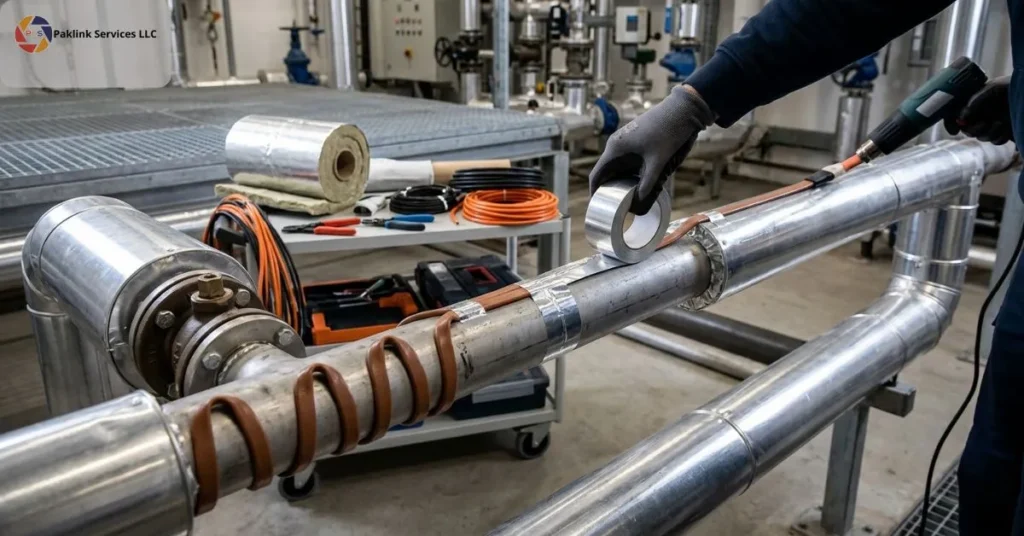
- Start with a spiral or zigzag wrapping of the cables around the pipe for pipes. Be sure each loop has some room.
- Along rooflines and gutters, position cables wherever snow and ice commonly gather. Where these form, proper drainage is maintained, preventing blockages that lead to damming. Fasten lines using durable clips made for outdoor conditions, securing them at regular intervals.
- For pathways: Run the wires around the route most often used by pedestrians. Since these places tend to accumulate ice, running the wires there will assist in reducing fall-offs.
4: Make the Electrical Connections
After the cables are installed, the following phase is to hook them to a power source. This is essential to guarantee the cables heat the region.
- For pipes: Run the connections to a weatherproof electrical box or outlet.
- Outdoor installations: With electrical tape, confirm every connection is tightly covered. Moisture stays out when seals are secure, avoiding operational problems.
Each electrical link for the Heat Tracing Installation must be verified a second time, ensuring safety along with protection against environmental exposure.
5: Test the System
Testing begins once connections are complete, confirming operations meet expected standards. System verification follows, allowing cables to reach proper thermal levels.
- For pipes: Check if the cables heat up by touch. The heat should be distributed uniformly throughout the pipe’s length.
- Check the surface of roofs or pathways for heat. This will verify whether the cables are in perfect working order.
Check the connections once more to ensure everything is correctly linked if the wires do not heat up.
6: Insulate (Optional)
Insulating heat trace wires can occasionally help to enhance their efficiency. Pipe systems in unheated environments or outdoor installations benefit most from this.
- Pipe wrapping should use foam insulation. This keeps the system warm, which increases its efficiency and effectiveness.
- For outdoor configurations, insulating the region around the wires keeps the heat concentrated where it is most needed.
While optional, insulating can improve the performance of the system, especially in colder regions.
7: Secure the Cables in Place
Ensuring each wire is securely attached prevents future shifting. When connections lack firmness, movement occurs – reducing overall performance steadily.
- For pipes: Every few inches, fasten the wires with cable ties. Though they shouldn’t be so tight as to risk damage, the wires should be securely attached.
- For pathways or roofs: Check that the cables are properly attached. Should necessary, include extra ties or clips to hold all in place.
Correct cable anchoring keeps them from moving or drooping, hence guaranteeing their consistent heating performance.
8: Perform Final Checks
Once everything is in order, it is essential to do a last check to be sure all is functioning properly. This enables the identification of any problems prior to application of the system.
Frequent inspection ensures each electrical link remains secure and properly sealed. Connection integrity depends on consistent verification over time. A lapse in scrutiny may compromise overall safety performance. Every junction demands attention to prevent unintended failures later.
Firmly attach each wire so none droop downward. With proper support, maintain steady positioning throughout. Where tension exists, correct alignment prevents looseness. Stability follows when connections stay fixed in place. Avoid Slack by securing every segment tightly. Through careful placement, ensure no hanging sections remain.
Upon reinspection of the wiring, proper heat distribution becomes evident. A second verification confirms alignment with expected performance. When examined closely, the connections show consistent thermal output. Following observation, functionality appears to be maintained across each segment. With careful review, operational status remains unchanged.
The system is ready for use once all the checks are finished.
9: Maintain the System
When installed, heat trace cables require consistent upkeep to remain functional. Throughout cold months, proper care ensures steady performance. Longevity follows only if attention continues after setup.
Regular inspection is advised. Wires must remain intact, free from damage that might compromise performance. Look closely at areas where exposure occurs. Breaks or cuts may appear over time. Functionality declines when outer coverings fail. Environmental contact increases the risk of disruption.
Washing is needed now because frost buildup restricts performance. When cleared, the operation remains stable through cold periods. What matters most shows up after several weeks without maintenance – function follows form only when surfaces stay bare.
Winter demands attention well ahead of its arrival. Consider the system’s performance through prior cold periods as a guide. A review months before frost appears allows time for adjustments. Functionality checks now reduce uncertainty when temperatures fall. Preparation quietly supports reliability once snow arrives.
A well-kept system tends to operate reliably over long spans.
Read also :- Heat Trace Cables: Complete Guide to Types Uses & More
Conclusion
Beginning with a clear plan for the Heat Tracing Installation helps avoid errors during setup. Without consistent checks, small faults may grow unseen. Performance stays strong when inspections occur at steady intervals. Winter after winter, the function depends on early preparation. Hidden beneath surfaces, wiring must endure without failure. Over time, resilience shows in uninterrupted service.