Industrial automation is reshaping global manufacturing by integrating robotics, artificial intelligence, and Industrial IoT into connected smart factory ecosystems. This guide explains what industrial automation is, how smart factories operate, what benefits manufacturers gain, and how automation companies implement these systems effectively.
What Is Industrial Automation?
Industrial automation refers to the use of control systems — including robotics, programmable logic controllers (PLCs), machine vision, and artificial intelligence — to operate manufacturing equipment with minimal human intervention. Unlike traditional mechanization, which simply replaces physical labor, automation introduces decision-making capabilities into machines through real-time data processing and adaptive algorithms.
An industrial automation company designs, integrates, and maintains these systems across factories, warehouses, and processing plants. Their engineers connect individual machines into unified production networks where every sensor, actuator, and controller communicates continuously.
The global industrial automation market reached $165 billion in 2023 and is projected to exceed $307 billion by 2030. Facilities adopting automation report approximately 30% higher output, while AI-driven systems reduce operational costs by around 25%. Surveys indicate that 60% of manufacturing plants plan major automation upgrades within five years — reflecting a fundamental shift in how goods are produced at scale.
What Is a Smart Factory and How Does It Work?
A smart factory is a digitally integrated production environment where sensors, industrial robots, edge computing, and AI systems form a self-optimizing network. Unlike conventional factories where machines operate independently, smart factories share operational data across every layer — from individual machine components to enterprise resource planning (ERP) systems.
Core Components of a Smart Factory
Smart factories function through the integration of several interconnected technology layers:
- Industrial IoT (IIoT) Sensors: Embedded sensors capture real-time data on temperature, pressure, vibration, and throughput from every machine on the production line.
- Edge Computing Infrastructure: Data is processed directly on the shop floor rather than transmitted to a central cloud, enabling millisecond response times for critical control decisions.
- Machine Vision Systems: High-resolution cameras and optical sensors inspect components at production speed, detecting defects, dimensional deviations, and assembly errors automatically.
- Collaborative Robots (Cobots): Unlike traditional industrial robots that require safety cages, cobots are designed to work alongside human operators, adapting their movements based on proximity sensors.
- AI-Driven Control Systems: Machine learning algorithms analyze historical and real-time production data to optimize machine parameters, predict failures, and adjust schedules without manual input.
How Smart Factories Manage Production in Real Time
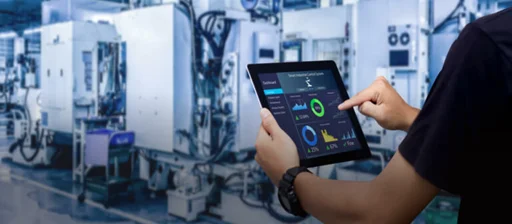
In a smart factory, production managers monitor every machine, workstation, and material flow from a centralized dashboard accessible via tablet or desktop. Controllers automatically adjust conveyor speeds, oven temperatures, and assembly sequences in response to demand changes or quality deviations — without stopping the production line.
Cross-functional data sharing connects production teams with procurement, logistics, and quality control. When a component supplier reports a delay, the system automatically reschedules production sequences and alerts relevant teams. Orders move from customer request to finished goods faster, and inventory levels are continuously aligned with actual demand rather than forecasts.
Key Benefits of Industrial Automation for Manufacturers
Manufacturers adopting industrial automation systems experience measurable improvements across production efficiency, product quality, workforce safety, and operating costs. These benefits emerge from the systematic replacement of manual processes with data-driven machine control.
Production Efficiency and Throughput
Automated production lines operate continuously without the downtime associated with manual labor shifts, breaks, or fatigue-related errors. Cycle times decrease as machines execute tasks at consistent speeds. A single robotic assembly cell can perform the work of multiple manual stations while maintaining tighter tolerances.
Quality Control and Defect Reduction
Machine vision systems inspect every part at line speed — something physically impossible for human inspectors. Defects are identified and removed before they progress to downstream processes, reducing scrap rates and rework costs. Statistical process control (SPC) systems track quality metrics continuously, triggering corrective action when measurements drift toward specification limits.
Workforce Safety
Industrial robots handle tasks that present physical risks to human workers — repetitive heavy lifting, exposure to hazardous chemicals, high-temperature environments, and precision assembly requiring unnatural body positions. Removing humans from these contexts eliminates a significant category of workplace injuries without reducing production output.
Rapid Product Changeover
Modern automation platforms allow production lines to switch between product variants in minutes. Programmable tooling, flexible robotic end-effectors, and recipe-based control systems enable small-batch custom manufacturing at near-mass-production efficiency. An industrial automation company configures these changeover capabilities during system integration.
Energy Efficiency and Sustainability
AI-controlled production systems optimize machine operating parameters in real time to reduce energy consumption. Motors run at variable speeds matched to actual load requirements rather than fixed rates. Smart sensors detect compressed air leaks, coolant loss, and heat waste, enabling rapid corrective maintenance. Some facilities have integrated solar generation and battery storage into their automation infrastructure, selling surplus energy back to the grid during low-production periods.
Key Technologies Powering Industrial Automation
Collaborative Robots (Cobots)
Cobots represent a distinct category of industrial robot designed for human-machine collaboration. Force-torque sensors enable cobots to detect contact and stop or redirect their movement before causing injury. Programming interfaces use visual drag-and-drop tools rather than complex code, allowing production operators to retask cobots without engineering support.
Predictive Maintenance Systems
Predictive maintenance uses vibration sensors, thermal imaging, and acoustic emission detectors to monitor the health of rotating equipment — motors, gearboxes, pumps, and spindles. Machine learning models establish baseline performance signatures and alert maintenance teams when measured parameters deviate, predicting failures days or weeks before they occur. This replaces time-based maintenance schedules with condition-based interventions, reducing both unplanned downtime and unnecessary component replacement.
Industrial IoT Platforms
Industrial IoT hubs aggregate data streams from hundreds of sensors, drives, and controllers across an entire facility. Standardized communication protocols — including OPC-UA, MQTT, and Modbus — allow equipment from different manufacturers to exchange data through a common platform. Operations teams gain unified visibility into uptime, energy consumption, production rates, and quality metrics from a single interface.
Machine Vision and Optical Inspection
Machine vision systems combine high-speed cameras, structured lighting, and image processing algorithms to perform dimensional measurement, surface inspection, barcode reading, and assembly verification. Modern vision systems process images in under one millisecond, operating without slowing production lines. 3D vision sensors extend inspection capability to complex curved surfaces and assembled components.
Digital Twins
A digital twin is a virtual replica of a physical machine, production line, or entire factory. Engineers use digital twins to simulate process changes, test new product introductions, and train control algorithms before implementing them on actual equipment. This eliminates the risk of unplanned downtime during production trials and reduces commissioning time for new automation systems.
Common Challenges in Implementing Industrial Automation
Legacy Equipment Integration
Most manufacturing facilities contain equipment installed across multiple decades. Older machines often lack digital communication interfaces, making direct integration with modern IIoT platforms difficult. Industrial automation companies resolve this through retrofit solutions — adding communication adapters, edge gateways, and protocol converters that extract data from older controllers without requiring equipment replacement.
Cybersecurity in Connected Manufacturing
Connecting production equipment to digital networks creates attack surfaces that did not exist in isolated manufacturing environments. Industrial control systems have become targets for ransomware and state-sponsored intrusion attempts. Effective industrial cybersecurity requires network segmentation between operational technology (OT) and information technology (IT) systems, strict access controls, encrypted communications, and regular vulnerability assessments conducted by specialists familiar with both manufacturing and security disciplines.
Workforce Skills Transition
Automation changes the skill requirements for manufacturing jobs rather than simply eliminating them. Operators who previously ran machines manually must learn to program, monitor, and troubleshoot automated systems. Data analysts, robot programmers, and controls engineers become essential roles. Manufacturers address this gap through partnerships with technical colleges, structured apprenticeship programs, and internal training academies that combine virtual reality simulation with hands-on equipment practice.
Capital Investment and Payback Period
Automation systems require substantial upfront investment in equipment, integration services, software licenses, and facility modifications. However, documented payback periods typically range from 12 to 18 months for well-scoped projects. Analysis across 100 manufacturing operations showed an average 22% profit increase following full automation deployment. Financing structures — including equipment leasing and project-based loans — allow manufacturers to deploy automation while spreading capital costs over the productive life of the system.
How to Implement Industrial Automation: A Step-by-Step Approach
Successful automation implementation follows a structured methodology that manages risk, builds organizational capability, and delivers measurable value at each stage.
- Production Assessment: Map existing production lines in detail, documenting cycle times, defect rates, labor requirements, and downtime frequency. Identify the highest-impact bottlenecks and manual processes as primary automation candidates.
- Objective Definition: Establish specific, measurable targets — cost reduction per unit, throughput increase, quality improvement — that will define project success and guide technology selection.
- Pilot Zone Selection: Choose a contained production area for the initial deployment. A single cell or workstation provides a controlled environment for proving technology performance without risking full production output.
- Cross-Functional Team Involvement: Include production operators, maintenance technicians, quality engineers, and IT staff from the project outset. Operator input during system design reduces post-deployment adjustment requirements and accelerates workforce acceptance.
- Controlled Trials: Run the automated system in parallel with existing processes before full cutover. Collect performance data, identify integration issues, and validate that the system meets defined objectives before expanding deployment.
- Performance Monitoring: Establish dashboards tracking key performance indicators — overall equipment effectiveness (OEE), first-pass yield, energy consumption per unit, and maintenance costs — to measure ROI and identify further optimization opportunities.
- Iterative Expansion: Use data from initial deployments to prioritize the next automation investment. Reinvest productivity gains into expanding the automation footprint across the facility.
Industrial Automation and Supply Chain Integration
The operational impact of industrial automation extends beyond the factory floor. Connected manufacturing systems link suppliers, production facilities, distribution centers, and logistics providers into a unified digital supply network.
Real-time inventory visibility eliminates the information delays that cause both stockouts and excess inventory. When production consumption rates change, procurement systems automatically adjust supplier orders. When inbound shipments are delayed, production scheduling systems reschedule work orders and reassign resources before the disruption reaches the line.
Cloud-based supply chain portals give supplier partners visibility into production schedules, demand forecasts, and quality requirements. This transparency enables suppliers to manage their own production planning more accurately, reducing the lead time variability that creates supply uncertainty. For manufacturers operating global supply networks, this level of integration provides resilience against regional disruptions by enabling rapid supply rerouting.
Human-Machine Collaboration in Modern Manufacturing
Industrial automation does not eliminate the human role in manufacturing — it transforms it. As robots and AI systems absorb repetitive, physically demanding, and hazardous tasks, human workers shift toward roles requiring judgment, problem-solving, and creativity.
On the shop floor, operators become robot programmers, setting new tasks through intuitive teach-pendant interfaces or simulation software. Quality technicians analyze the data streams generated by automated inspection systems rather than performing manual checks. Maintenance engineers use predictive analytics dashboards to plan interventions rather than responding to failures after they occur.
Cobots exemplify this collaborative model at the workstation level. A cobot handles the heavy lifting or precision repetitive movement while the human operator performs the fine-motor or judgment-dependent portions of an assembly task. The combination consistently outperforms either humans or robots working independently, achieving higher throughput, better quality, and lower injury rates simultaneously.
The Future of Industrial Automation
Autonomous Mobile Robots (AMRs)
Next-generation autonomous guided vehicles will navigate factory floors without fixed tracks or magnetic tape, using lidar, camera systems, and simultaneous localization and mapping (SLAM) algorithms to move materials dynamically. AMRs reconfigure their routes in real time as production layouts change, eliminating the rigidity of conventional conveyor-based material handling.
Augmented Reality for Maintenance and Training
Augmented reality systems overlay digital information onto the physical environment through headsets or tablet interfaces. Maintenance technicians see step-by-step repair instructions superimposed on equipment components without consulting paper manuals. New operators complete training simulations on virtual equipment representations before working with actual production systems, reducing training time and error rates.
AI-Driven Production Planning
Advanced AI systems will analyze global demand signals, commodity market data, and production capacity simultaneously to optimize manufacturing schedules weeks in advance. These systems will identify supply risk before procurement teams do and initiate mitigation actions — alternative supplier qualification, inventory pre-positioning, or production sequence adjustment — autonomously.
Tactile and Multimodal Robotics
Emerging robotic systems incorporate tactile sensors that detect pressure, texture, and compliance — enabling manipulation of fragile, irregular, or compliant components that current robots cannot handle reliably. Combined with acoustic sensing and advanced vision, these multimodal robots will access assembly tasks currently reserved for human dexterity.
Conclusion
Industrial automation has transitioned from a competitive advantage to an operational necessity for manufacturers competing in global markets. The integration of robotics, AI, Industrial IoT, and machine vision into smart factory ecosystems delivers measurable improvements in production efficiency, product quality, workforce safety, and environmental sustainability.
The challenges of legacy integration, cybersecurity, and workforce transition are real but manageable through structured implementation methodologies and investment in human capability alongside technology. Industrial automation companies that combine deep engineering expertise with change management competence consistently deliver faster payback and higher long-term value from automation investments.
As digital twin technology, autonomous mobile robots, and AI-driven planning systems mature, the manufacturing facilities that have already built foundational automation capability will extend their advantage further — operating with agility, resilience, and efficiency that purely manual production cannot match.
FAQ
What does an industrial automation company do?
An industrial automation company designs, integrates, and maintains automated systems for manufacturing facilities. Their scope includes selecting appropriate robotics and control systems, writing control software, connecting machines to IIoT platforms, and training facility staff. They manage the full implementation lifecycle — from production assessment through commissioning and ongoing technical support — ensuring that automated systems deliver the performance and ROI targets defined at project outset.
What is the difference between industrial automation and a smart factory?
Industrial automation refers to individual technologies — robots, PLCs, sensors — that replace or assist manual tasks. A smart factory is the complete ecosystem created when these technologies are networked together and connected to data analytics platforms. Industrial automation is the component layer; a smart factory is the integrated operational result. A facility can deploy industrial automation without becoming a smart factory, but every smart factory depends on industrial automation as its foundation.
How long does it take to see ROI from manufacturing automation?
Most manufacturing automation projects achieve payback within 12 to 18 months. Facilities that have completed full automation deployments report an average 22% increase in profitability. Payback speed depends on the complexity of the installation, the baseline efficiency of replaced processes, and how effectively the organization uses the performance data the system generates. Projects with clearly defined objectives, well-scoped pilot deployments, and strong operator engagement consistently deliver faster returns.
What are collaborative robots and how are they different from industrial robots?
Collaborative robots, or cobots, are designed to share workspace with human operators without safety cages. They use force-torque sensors to detect unexpected contact and stop or redirect movement before causing injury. Traditional industrial robots are programmed for fixed, high-speed tasks in isolated cells. Cobots are flexible, quickly reprogrammable, and suited to tasks that combine human judgment with robotic precision and endurance. They are particularly effective in assembly, inspection, and material handling applications where complete automation is impractical.
How does predictive maintenance reduce manufacturing downtime?
Predictive maintenance systems monitor vibration, temperature, acoustics, and electrical signatures from rotating equipment in real time. Machine learning models establish normal performance baselines and detect deviations that indicate developing faults — bearing wear, motor imbalance, gear degradation. Maintenance teams receive alerts days or weeks before failure occurs, allowing planned interventions that prevent unplanned production stops. This approach replaces reactive breakdown repairs and scheduled time-based maintenance with condition-based interventions, reducing both downtime frequency and unnecessary component replacement costs.
What cybersecurity risks exist in connected manufacturing environments?
Connected manufacturing environments are vulnerable to ransomware attacks that lock control systems, industrial espionage targeting production data and intellectual property, and supply chain intrusions that enter through supplier network connections. Effective protection requires segmenting operational technology networks from IT systems, enforcing strict access controls with multi-factor authentication, encrypting all external communications, and conducting regular vulnerability assessments by specialists familiar with industrial control system architecture. Employee security awareness training is equally critical, as social engineering remains a primary attack vector.
How does automation support sustainability goals in manufacturing?
Automation supports sustainability through several mechanisms. AI-controlled machines operate at variable speeds matched to actual production demand, reducing energy waste significantly. Sensor networks detect compressed air leaks, coolant loss, and heat inefficiency in real time, enabling immediate corrective action. Some facilities integrate solar generation and energy storage with their automation infrastructure, selling surplus energy back to the grid. The combined effect is measurable reduction in energy consumption per unit produced and measurable progress toward zero-carbon manufacturing targets without sacrificing output volume or quality.
What skills do manufacturing workers need in automated factories?
Automated factories require workers who can program and troubleshoot robotic systems, interpret data from IIoT dashboards, apply statistical process control methods, and perform condition-based maintenance on complex electromechanical equipment. Manual dexterity remains important for assembly tasks beyond current robot capability. Manufacturers address the skills transition through partnerships with technical colleges, internal training programs using virtual reality simulation, and structured apprenticeships that combine classroom instruction with hands-on equipment practice. Workers who develop these competencies typically advance into higher-value roles as robot programmers, automation technicians, and data analysts.
What is a digital twin in manufacturing?
A digital twin is a virtual model that replicates the behavior of a physical machine, production line, or entire facility. Engineers use digital twins to simulate process changes, test new product introductions, and validate control algorithm updates before implementing them on real equipment. This eliminates production risk during development phases and significantly reduces commissioning time for new automation projects. Digital twins also enable continuous performance optimization by allowing engineers to test parameter changes virtually before applying them to live production systems, identifying improvements without risking output disruption.
How does industrial automation integrate with supply chains?
Automated manufacturing systems connect suppliers, production facilities, and distribution centers into a unified digital supply network. Real-time inventory visibility eliminates the information delays that cause both stockouts and excess inventory accumulation. When production consumption rates change, procurement systems automatically adjust supplier orders. When inbound shipments are delayed, production scheduling systems reschedule work orders and reassign machine resources before the disruption reaches the production line. Cloud-based supply chain portals give supplier partners direct visibility into production schedules and demand forecasts, enabling more accurate upstream planning and reducing the lead time variability that creates supply uncertainty across the network.