What Is the AKYTEC ITP17 Universal Indicator?
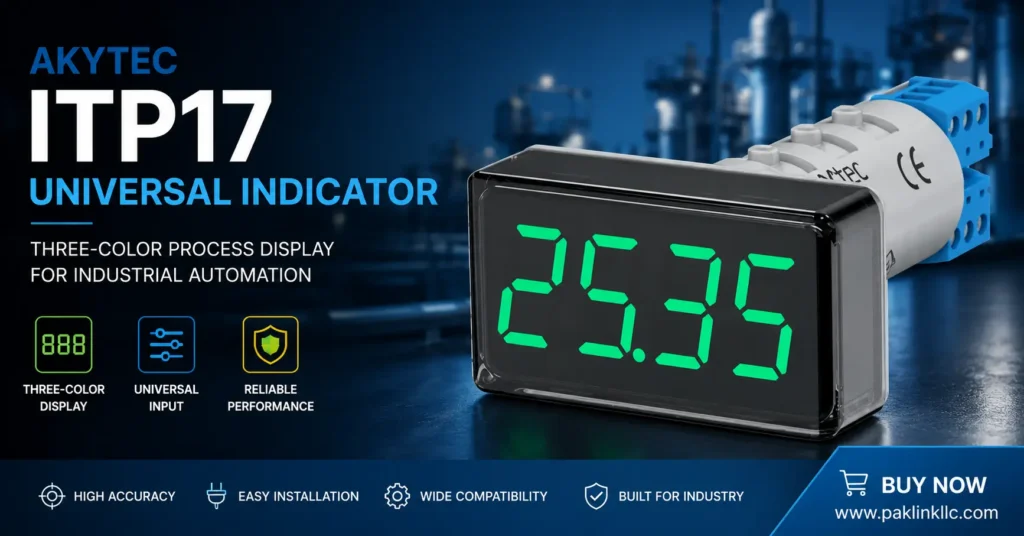
The AKYTEC ITP17 is a universal-input digital process indicator built for panel-mounted monitoring in industrial automation systems. It displays measured values on a 4-digit, three-color seven-segment LED display — switching automatically between green, yellow, and red as the process value crosses operator-defined thresholds. Instead of reading a number and mentally judging whether it is safe, an operator sees the status at a glance from across a control room or process cabinet.
Unlike single-signal meters, the ITP17 accepts a wide range of inputs from one device: current loops, voltage signals, RTDs, and thermocouples. This makes it a genuine “universal” indicator rather than a temperature-only or current-only display — one part number can be specified across multiple process variables (temperature, pressure, level, flow, or humidity), which simplifies procurement and spares holding for EPC contractors and panel builders across the UAE and wider GCC.
Key Technical Specifications
| Specification | Detail |
|---|---|
| Display | 4-digit, three-color (green/yellow/red) seven-segment LED |
| Analog input | 0–5 mA, 0(4)–20 mA, 0(2)–10 V |
| Sensor inputs | RTD (Pt, Cu, Ni) and thermocouples (types B, J, K, N, R) |
| Control output | Built-in NPN transistor output, 200 mA / 42 V, for ON/OFF control or alarm signaling |
| Power supply | External DC, 10–30 V |
| Operating modes | Continuous value display, or three-color threshold indication |
| Alarm behavior | Automatic color change and/or blinking on signal loss or limit breach |
| Programming | Micro USB port with free akYtec Tool Pro software, or 3 onboard buttons |
| Terminals | Removable screw terminals for faster installation and maintenance |
| Mounting | Fits a standard 22.5 mm borehole (signal-lamp cutout) |
| Ingress protection | IP65 from the front panel; IP20 at the rear terminal block |
| Operating temperature | −40 °C to +60 °C |
These figures matter for spec-driven buyers — consultants and panel builders in Oil & Gas, Marine, and Industrial projects typically shortlist indicators by IP rating and operating temperature range before price, since GCC ambient conditions and offshore/onshore panel environments demand both.
How the Three-Color Threshold System Works
The ITP17’s core value proposition is condition-at-a-glance monitoring. The operator sets color-change thresholds against the measured range:
- Green — process value within the normal operating band
- Yellow — value approaching a warning limit
- Red — value has crossed an alarm or critical limit
The device can be configured in one of two modes:
- Continuous indication — the display always shows the live process value, with the LED color changing in the background as thresholds are crossed.
- Threshold indication — the display uses color and blinking to flag status changes, prioritizing visibility of the condition over the exact number.
This dual-mode behavior is what separates a “universal indicator” from a basic digital panel meter: it functions simultaneously as a numeric readout and a visual alarm annunciator, reducing the number of separate indicator lights needed on a panel face.
Supported Input Signals and Sensor Compatibility
The ITP17 can be wired directly to:
- Current loop signals: 0–5 mA, 0–20 mA, or 4–20 mA
- Voltage signals: 0–10 V or 2–10 V
- RTDs: Pt100 and other Pt/Cu/Ni resistance elements
- Thermocouples: types B, J, K, N, R
A common technical question from specifiers is whether a Pt100 RTD can be wired directly to the ITP17 without a separate 4–20 mA transmitter/converter. It can — the ITP17’s universal input accepts the RTD signal natively, which removes a component (and a failure point) from the loop compared to indicators that only accept 4–20 mA.
Installation and Configuration
- Mounting: The housing is sized for a standard 22.5 mm borehole — the same cutout used for panel signal lamps and pushbuttons — so it drops into existing panel layouts without a custom rectangular cutout.
- Wiring: Removable screw terminals at the rear allow the indicator to be pre-wired and clipped in during panel assembly, or swapped out for maintenance without re-terminating cables.
- Configuration: Thresholds, decimal point position, input type, and alarm behavior are set either via the three onboard buttons or through the akYtec Tool Pro software over the Micro USB port — useful when a technician needs to reconfigure several units from a laptop rather than button-by-button on-panel.
Where the ITP17 Is Used in GCC Industrial Facilities
Because it accepts nearly every common process signal, the ITP17 is specified across several monitoring functions rather than one narrow use case:
- Temperature measurement — RTD/TC-fed panels in process skids, heat tracing control cabinets, and utility rooms
- Level and flow monitoring — 4–20 mA transmitter readouts on tanks, sumps, and pipelines
- Pressure control systems — local indication alongside pressure transmitters on compressors and pump skids
- Humidity and environmental monitoring — HVAC and cleanroom-adjacent applications
- Automation and control panels — general-purpose status indication in MCC and PLC panels
- Process safety and alarm systems — visual color-coded alarming that supplements audible alarms
- Energy management — status indication within energy monitoring panels
These map directly onto the sectors Paklink LLC serves — Oil & Gas, Marine, Construction, and Industrial — where panel builders need one indicator SKU that can be re-specified across multiple signal types on the same project.
ITP17 vs ITP16 vs ITP14: Choosing the Right akYtec Indicator
Paklink also stocks the ITP16 and other akYtec indicators, so buyers often need to know which model fits their signal type before ordering.
| Model | Input Type | Display | Best For |
|---|---|---|---|
| ITP14 | 0–10 V / 4–20 mA | Single-color, alarm blink | Simple ON/OFF process control with basic alarm blinking |
| ITP16 | RTD / thermocouple / current / voltage | Multi-color | Temperature-focused monitoring with multi-color status |
| ITP17 | Current, voltage, RTD, and thermocouple (all in one) | 3-color (green/yellow/red) | Universal signal monitoring where the same indicator model must cover multiple process variables across a project |
The practical distinction: choose the ITP14 for straightforward ON/OFF indication on a single signal type, the ITP16 where temperature sensing is the primary requirement, and the ITP17 where a project has mixed signal types (current, voltage, and temperature sensors) and standardizing on one universal part number reduces spares complexity.
For loop-powered wall-mount applications instead of panel mounting, the ITP11-W is the relevant akYtec alternative.
Why Buy the ITP17 Universal Indicator from Paklink LLC
Paklink LLC supplies the AKYTEC ITP17 across the UAE, Qatar, Saudi Arabia, Oman, Bahrain, and Kuwait, backed by:
- Genuine akYtec stock with datasheets and wiring guidance in English
- Technical support for signal type selection (current vs. voltage vs. RTD/TC) before ordering
- Delivery to project sites and panel-building workshops across the GCC
- Support for the wider akYtec indicator range (ITP14, ITP16, ITP17, ITP11-W) so panels can standardize on one supplier
Get a Quote for the ITP17 Universal Indicator
Conclusion
The AKYTEC ITP17 earns the “universal” name by combining current, voltage, RTD, and thermocouple input compatibility with a three-color threshold display in a single 22.5 mm panel-mount housing. For UAE and GCC panel builders working across mixed signal types on the same project, it reduces the number of distinct indicator part numbers needed on a BOM. Paklink LLC supplies the ITP17 alongside the rest of the akYtec indicator range for projects across the region.
Frequently Asked Questions
What signal types does the ITP17 universal indicator support?
The ITP17 accepts current signals (0–5 mA, 0–20 mA, 4–20 mA), voltage signals (0–10 V, 2–10 V), RTDs, and thermocouples — configurable per installation.
Can the ITP17 be connected directly to a Pt100 RTD, or is a converter needed?
It can be wired directly to a Pt100 RTD without a separate 4–20 mA converter, since the universal input accepts RTD signals natively.
How is the ITP17 configured?
Either using the three buttons on the device body, or via the free akYtec Tool Pro software connected through the Micro USB port.
What is the ingress protection rating of the ITP17?
IP65 from the front panel (protected against dust and water jets) and IP20 at the rear terminal block, since the terminals are exposed for wiring.
What is the operating temperature range?
−40 °C to +60 °C, suitable for both indoor panel environments and less climate-controlled industrial enclosures.
What size cutout does the ITP17 need?
A standard 22.5 mm borehole — the same size used for panel-mount signal lamps and pushbuttons.
What power supply does the ITP17 require?